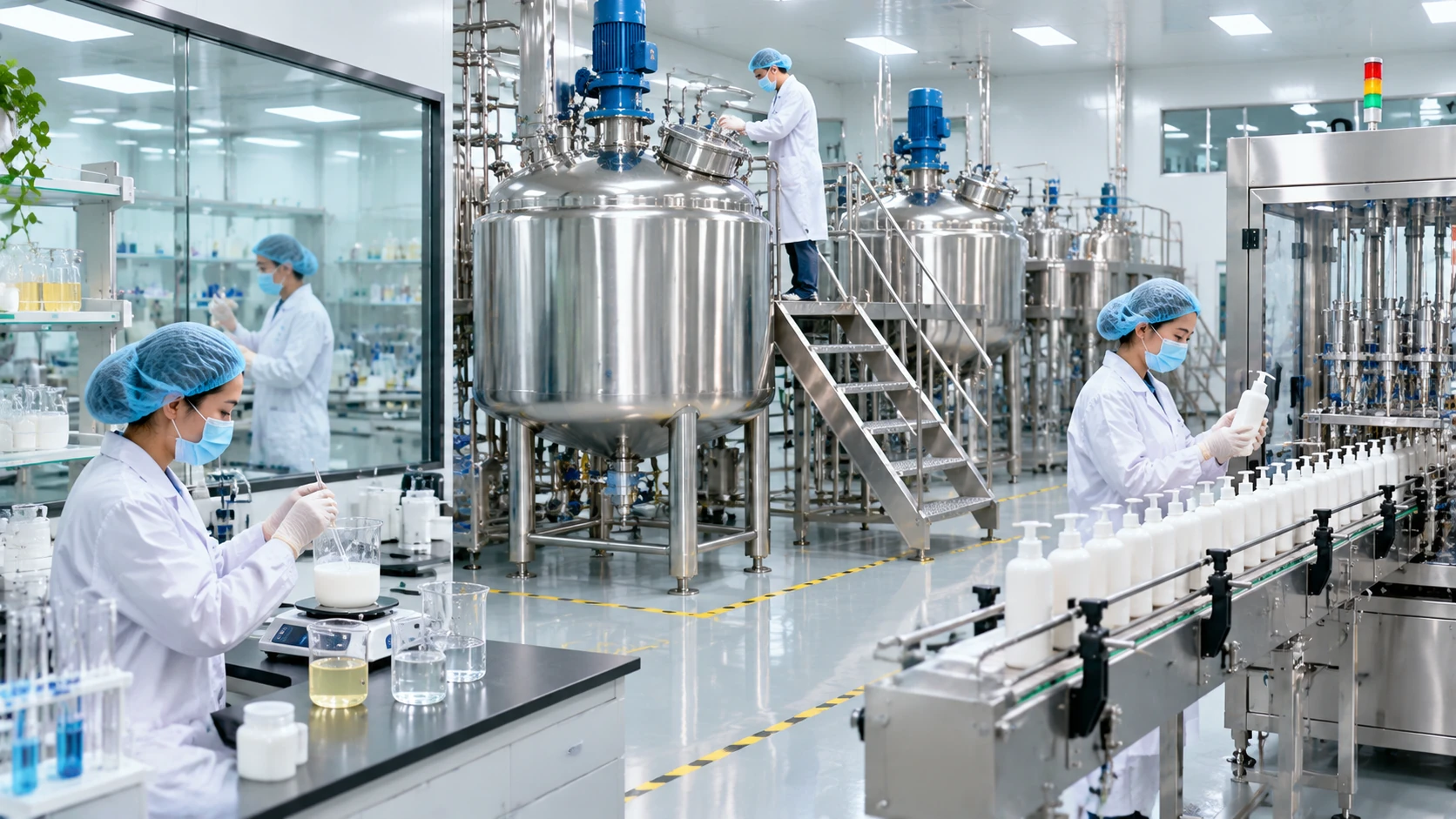
A successful shampoo formula is only the beginning of a commercial product. The real challenge is transferring that formula from laboratory development to consistent, repeatable manufacturing.
For brands planning private label shampoo development, understanding the shampoo manufacturing process helps clarify how raw materials are controlled, how samples are approved, how production is scaled up, and how finished products are inspected before shipment.
Each stage plays an important role in product quality. A formula that performs well in a laboratory sample may behave differently in a large mixing vessel, while unsuitable processing conditions can affect viscosity, appearance, fragrance and overall consistency.
This guide explains the shampoo manufacturing process step by step, from initial formula development and raw material qualification to stability testing, pilot production, bulk manufacturing and quality control.
Overview of the Shampoo Manufacturing Process
Commercial shampoo manufacturing involves several connected stages. Each stage has its own requirements and quality checkpoints before the product moves forward.
| Manufacturing Stage | Main Activities | Key Objective |
|---|---|---|
| 1. Formula Development | Product brief, laboratory formulation and benchmarking | Establish the approved product concept |
| 2. Raw Material Qualification | Supplier review, incoming inspection and COA verification | Confirm raw material quality |
| 3. Laboratory Sampling | Sample preparation, evaluation and approval | Establish the Golden Sample |
| 4. Testing and Validation | Stability, microbiological and packaging evaluation | Assess product readiness |
| 5. Pilot Batch and Scale-Up | Production trials and process optimization | Verify manufacturing feasibility |
| 6. Bulk Production and Filling | Mixing, quality checks, filling and packing | Produce consistent finished goods |
The exact workflow may vary depending on the formula, packaging, order quantity and target market. However, maintaining clear approval points between these stages helps reduce production risks and unnecessary changes.
Stage 1: Concept and Formula Development
Every shampoo manufacturing project begins with a clear product brief.
Before laboratory work starts, the brand and manufacturer need to establish the intended product type, target hair condition, desired cleansing experience, fragrance direction, packaging format and target price positioning.
For example, a moisturizing shampoo, a clarifying shampoo and a sulfate-free shampoo require different formulation approaches. These requirements influence raw material selection, formula structure and subsequent manufacturing considerations.
Once the brief is established, the R&D team develops The R&D team develops laboratory formulations using a suitable surfactant system, conditioning ingredients, preservatives, fragrance and viscosity modifiers.
Existing formula bases may provide a practical starting point for some projects, while fully customized development offers greater flexibility for brands seeking distinctive product characteristics.
Benchmarking can also be used to evaluate the sensory profile and performance of the proposed formula against relevant market references.
At this stage, the objective is to establish a formula that meets the agreed product specifications while remaining suitable for testing, packaging and future commercial production.
Stage 2: Raw Material Selection and Qualification
A consistent shampoo manufacturing process depends on the quality and reliability of its raw materials.
Before production, manufacturers need to establish appropriate supplier controls and incoming material inspection procedures.
Raw materials should be checked against their approved specifications. Depending on the ingredient and supplier documentation, this may include identity, appearance, physical properties and other relevant quality parameters.
A Certificate of Analysis (COA) provides important information about a material lot and its specified quality characteristics. Manufacturers should review the documentation and conduct appropriate incoming checks before releasing materials for production.
Destination-market requirements should also be considered during ingredient selection. Certain ingredients may have restrictions, concentration limits or specific labeling requirements in the intended market.
Preservative selection is another important part of formulation qualification. The preservation system must be compatible with the complete formula and supported by appropriate evaluation.
Manufacturing water also requires suitable quality controls. Depending on the facility's process, purified water systems such as reverse osmosis and deionization may be used to reduce unwanted minerals and other impurities that could affect product quality.
These controls help establish a reliable starting point before the shampoo enters laboratory sampling and commercial manufacturing.
Stage 3: Laboratory Samples and Golden Sample Approval
After the initial formula is prepared, laboratory samples are provided for evaluation.
Brands typically assess fragrance, appearance, foam, viscosity, cleansing feel and the hair's after-wash condition. Feedback from these evaluations helps the formulation team determine whether adjustments are needed.
Some projects may require only minor refinements, while more customized formulas can involve additional sample revisions. The number of sample rounds depends on the complexity of the project and how clearly the initial requirements have been defined.
Laboratory measurements also help support the evaluation process. Depending on the formula, these may include pH, viscosity, appearance and other relevant product specifications.
Once the brand approves the final sample, it becomes the Golden Sample, which serves as a reference for subsequent manufacturing batches.
Importantly, Golden Sample approval should be accompanied by written quality specifications. These may include agreed appearance, fragrance, pH, viscosity and other relevant acceptance criteria.
This gives both the brand and manufacturer a clearer reference when reviewing pilot batches and repeat production.
Stage 4: Stability, Safety and Compatibility Testing
Before commercial production, the approved formula needs appropriate testing and evaluation.
Testing requirements depend on the formula, intended use, packaging and target market. The objective is to identify potential quality or safety issues before the product enters regular manufacturing.
Stability Testing
Stability testing evaluates how a shampoo behaves under selected storage conditions.
Depending on the development protocol, samples may be exposed to elevated temperatures, lower temperatures, freeze-thaw cycles or other relevant conditions.
The evaluation may monitor changes in appearance, color, fragrance, pH and viscosity, as well as signs of separation or other physical changes.
Accelerated testing can provide useful early information, but it should not automatically be treated as a substitute for real-time stability data.
Microbiological and Preservation Testing
Most shampoos contain a significant water phase, making microbiological quality an important consideration.
Microbiological testing evaluates the product's microbial condition, while preservative efficacy testing, also known as challenge testing, assesses whether the preservation system can control microbial growth under the selected test conditions.
The appropriate testing approach should be determined according to the formula, product risk and applicable requirements.
Packaging Compatibility and Safety Assessment
The shampoo should also undergo packaging compatibility evaluation in its intended bottle, pump or tube.
Potential issues include leakage, changes in appearance, material interaction, dispensing problems and deterioration of closure performance.
A separate safety assessment should address the product's intended use and applicable market requirements. This is distinct from stability or microbiological testing.
| Testing Area | What It Evaluates | Why It Matters |
|---|---|---|
| Stability Testing | Appearance, fragrance, pH and viscosity changes | Supports product quality throughout storage |
| Microbiological Testing | Microbial quality | Helps evaluate product safety |
| Preservative Efficacy | Performance of the preservation system | Supports preservation strategy |
| Packaging Compatibility | Formula and packaging interaction | Reduces leakage and dispensing risks |
| Safety Assessment | Safety for intended use | Supports applicable market requirements |
Completing appropriate testing before production approval helps reduce the risk of costly reformulation or packaging changes after launch.
Stage 5: Pilot Batch and Manufacturing Scale-Up
One of the most important stages in commercial shampoo manufacturing is transferring the approved laboratory formula to larger production equipment.
A formula that works well in a small laboratory beaker does not automatically behave the same way in a large mixing vessel.
As production volume increases, heat transfer, mixing efficiency, shear conditions and ingredient addition order can all influence the finished product.
Why Pilot Batch Production Matters
A pilot batch allows the manufacturer to evaluate how the formula behaves using production-relevant equipment and processing conditions.
During this stage, the team can identify potential issues such as excessive aeration, viscosity differences, incomplete dispersion or changes in fragrance performance.
These observations help determine whether the laboratory process needs to be adjusted before full-scale production.

Establishing Manufacturing Parameters
Once the pilot batch has been evaluated, relevant production parameters can be documented and standardized.
Depending on the formula, these may include mixing speed, processing temperature, heating and cooling rates, ingredient addition order and holding time.
The objective is to establish a reproducible manufacturing procedure that can be followed during subsequent production batches.
Filling Trial and Process Verification
Pilot production can also be used to evaluate the actual filling process.
The shampoo is tested with its intended packaging to confirm suitable flow behavior, filling accuracy, closure application and dispensing performance.
This is particularly important for products with different viscosity profiles or specialized pump and closure systems.
Successful scale-up connects laboratory development with practical manufacturing requirements and provides a stronger foundation for repeat production.
Stage 6: Bulk Shampoo Production and Filling
Once the pilot batch and relevant specifications have been approved, the project can proceed to commercial bulk production.
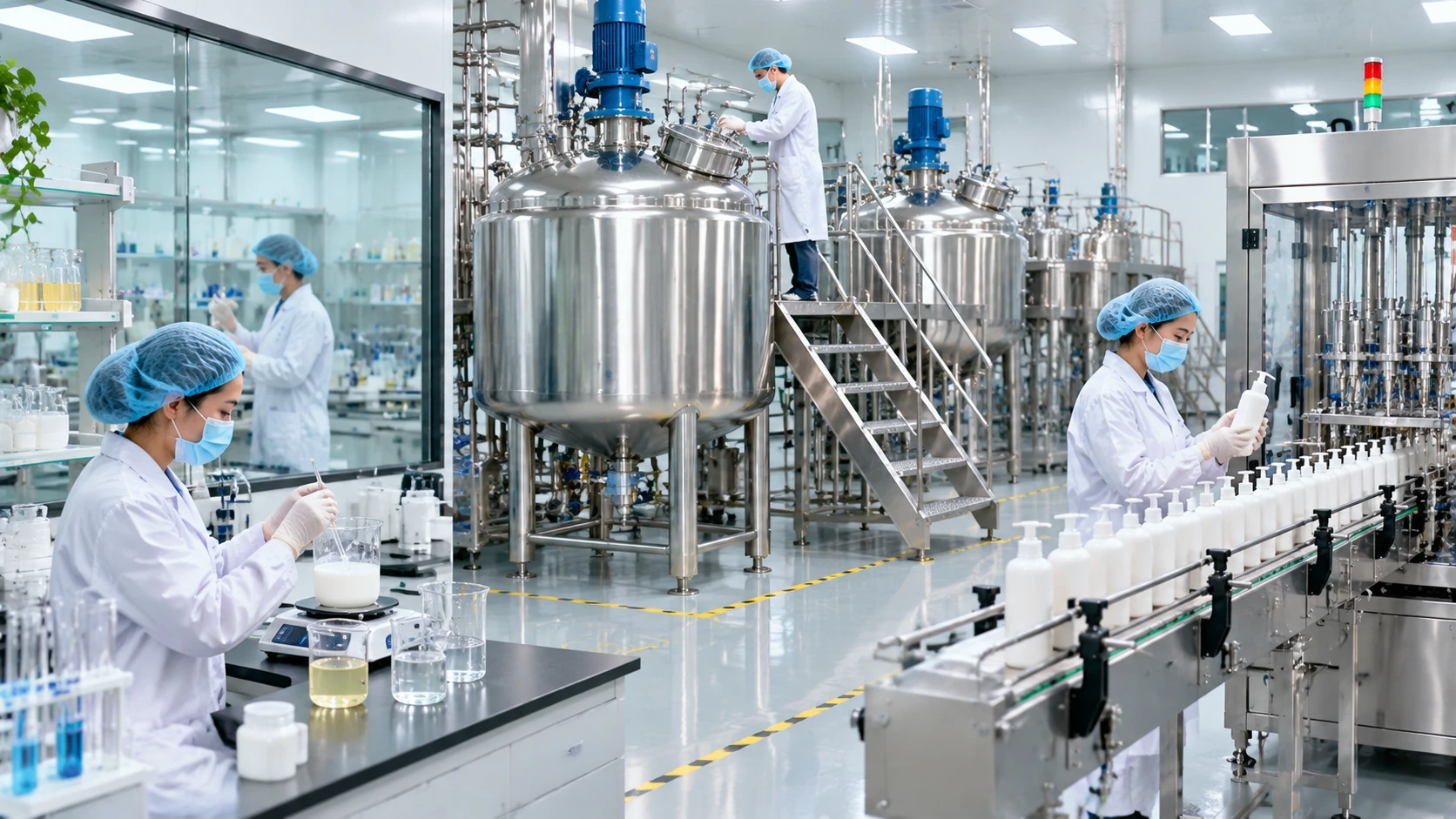
Although the exact process varies by formula and equipment, shampoo manufacturing generally involves several controlled operations.
Water Preparation and Ingredient Addition
Production begins with the preparation and verification of the required water phase.
The manufacturing team then introduces ingredients according to the approved formula and processing instructions.
The order of addition matters because some materials require sufficient dispersion or dissolution before other ingredients are introduced.
Controlled Mixing and Processing
Surfactants, conditioning agents and viscosity modifiers are incorporated under controlled processing conditions.
Temperature and mixing intensity must be appropriate for the formula. Excessive aeration, unsuitable mixing or incomplete dispersion can affect product appearance and consistency.
The production team follows the established manufacturing procedure rather than relying on a general mixing sequence for every shampoo.
Cooling and Final Adjustments
After the main mixing stage, the batch is processed according to its specified cooling requirements.
Certain heat-sensitive ingredients, fragrances and other selected components may be introduced during the appropriate stage of cooling.
The formula is then checked against the approved specifications. Where necessary and permitted by the manufacturing procedure, controlled adjustments are made before batch release.
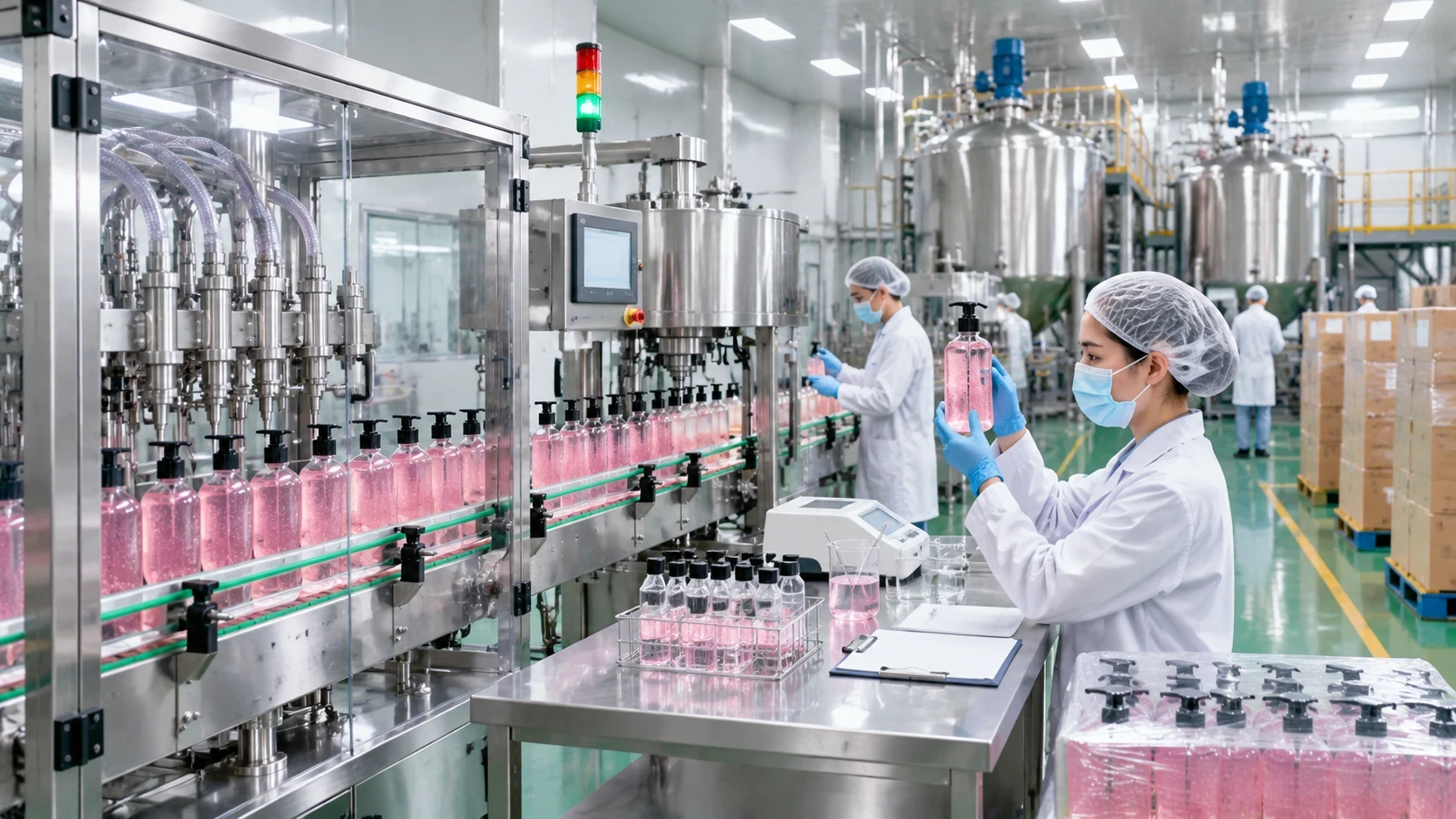
In-Process Quality Control and Filling
Samples may be collected during production to evaluate pH, viscosity, appearance and other relevant parameters.
Once the batch meets the established release requirements, it proceeds to filling and packaging.
Filling operations include checking the filling quantity, container condition, closure application and batch coding.
Finished products are then labeled, packed into cartons and prepared according to the agreed shipping and documentation requirements.
Maintaining production records throughout these operations helps connect the finished goods with their corresponding raw material lots and manufacturing batch.
Quality Control, Batch Traceability and Documentation
A reliable shampoo manufacturing process requires a quality management system that supports consistency across production batches.
Good Manufacturing Practices provide a framework for controlling personnel, premises, equipment, production procedures and documentation. Working with an experienced OEM/ODM manufacturing partner can help brands establish clearer production and quality expectations. ISO 22716 is an internationally recognized guideline for cosmetic GMP.
For private label brands, the practical value of quality management lies in knowing that production activities are documented and that quality issues can be investigated when necessary.
Batch manufacturing records connect raw material lots with processing information and finished product batches. This supports traceability and helps manufacturers investigate deviations or customer complaints.
Finished-product inspection should follow agreed quality specifications, which may cover appearance, odor, pH, viscosity, filling quantity, packaging condition and other relevant requirements.
Change control is equally important. Any significant change to the approved formula, raw material source, processing conditions or packaging should be evaluated and approved according to the applicable quality procedures.
Manufacturing documentation may include batch records, COAs, SDS, product specifications and other technical information required for the project.
For export markets, manufacturers can support the brand with relevant technical and production documentation. However, legal product notification, safety documentation and market-specific regulatory responsibilities must be coordinated with the brand and its designated regulatory parties.
How Long Does Shampoo Manufacturing Take?
The time required for shampoo manufacturing depends on the degree of formula customization, testing requirements, packaging availability, order quantity and production schedule.
Existing formula bases may shorten the initial development stage, while customized formulations generally require additional sampling and evaluation.
Testing may extend across several weeks or longer depending on the selected protocols and market requirements. Pilot production, packaging approval and bulk manufacturing also require coordination.
For this reason, brands should plan their launch schedules around the complete project rather than considering only the time required to manufacture and fill the finished shampoo.
Providing a clear product brief, approving samples promptly and confirming packaging specifications early can help reduce avoidable delays.
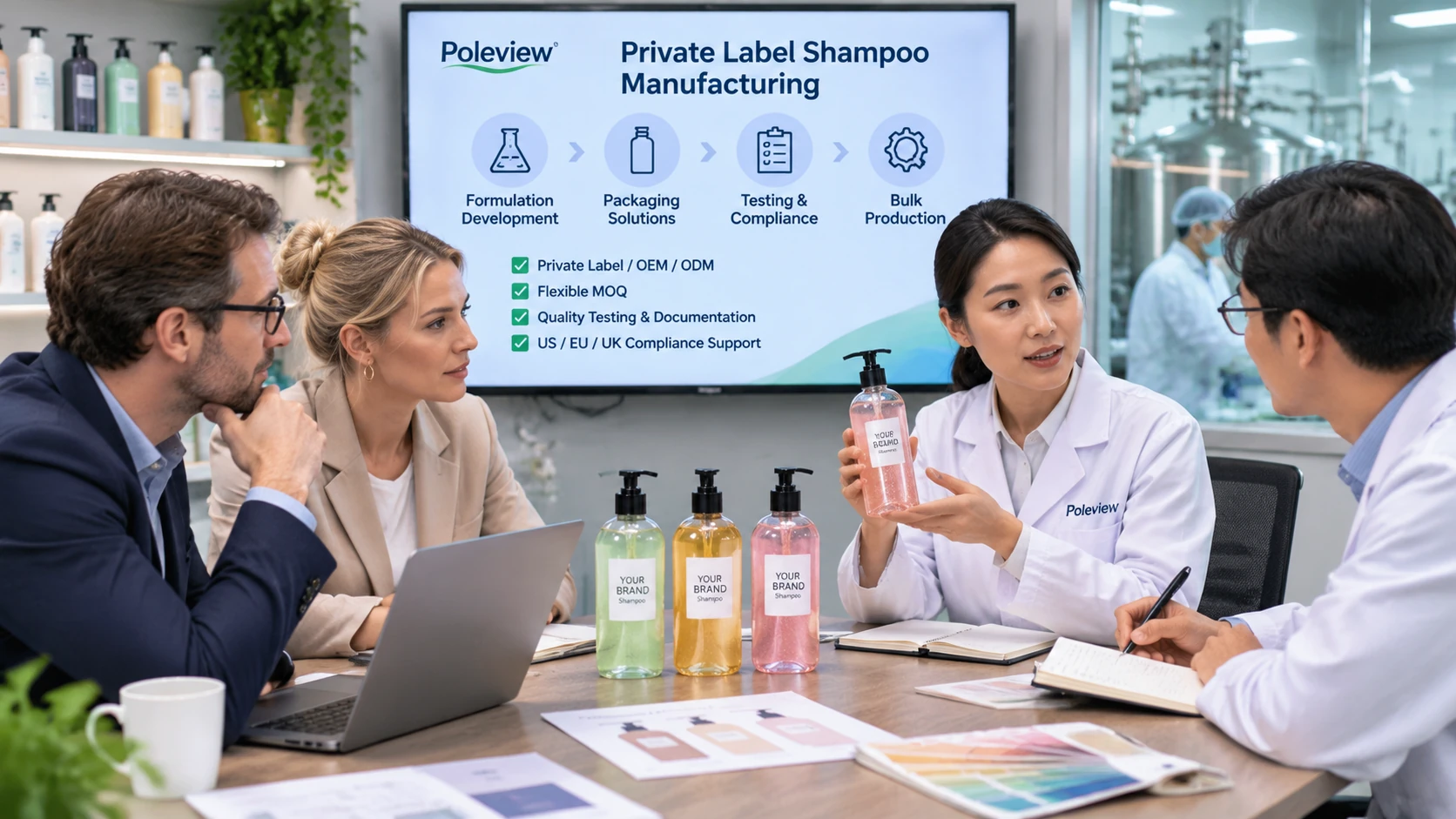
Shampoo OEM/ODM Manufacturing With Poleview
Poleview Biotechnology Group Co., Ltd. supports international hair care brands with private label shampoo development and OEM/ODM manufacturing.
Our manufacturing approach connects formula development, sample evaluation, production preparation, quality control and bulk manufacturing within a coordinated project process.
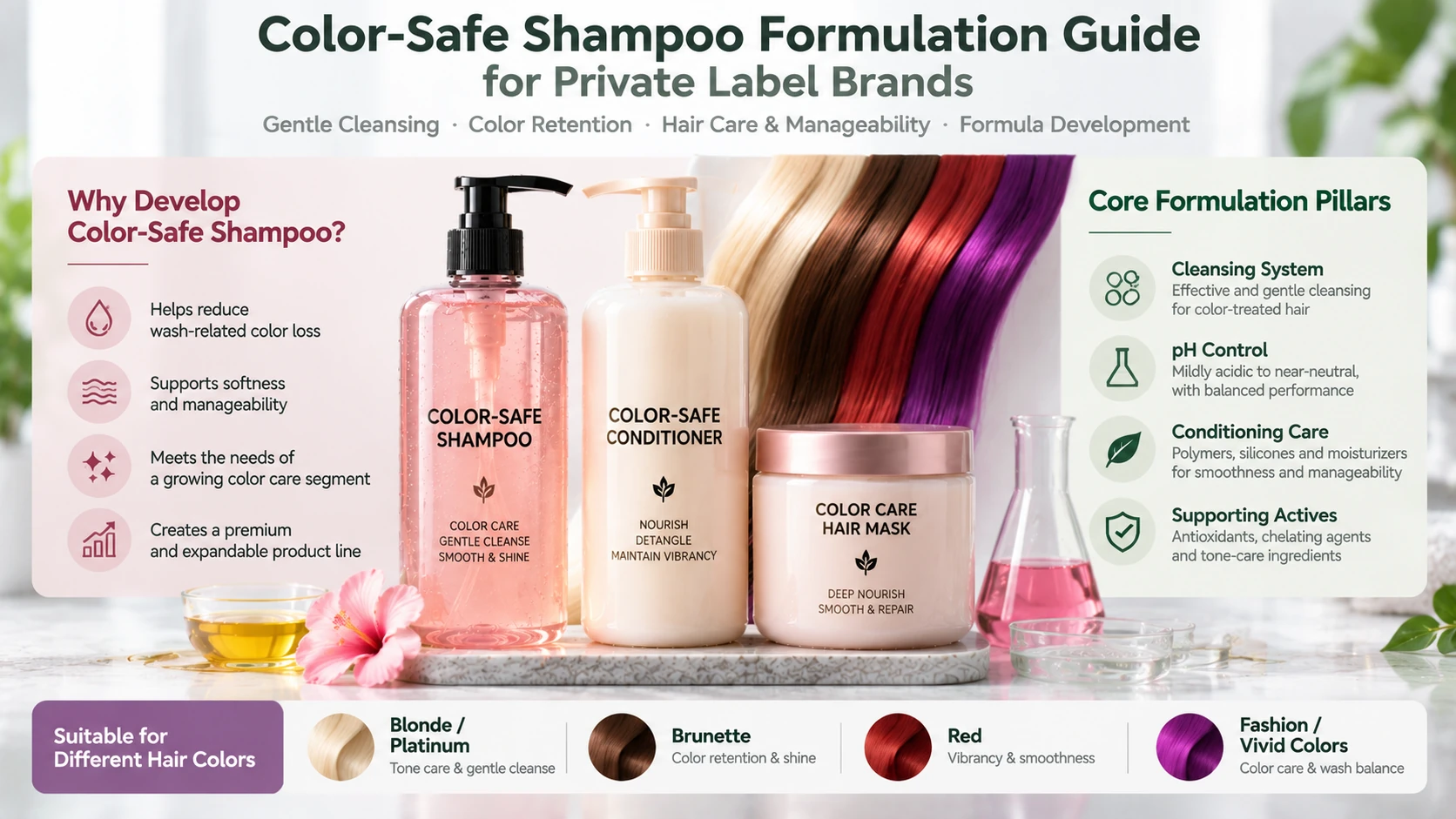
Depending on project requirements, brands can explore moisturizing, clarifying, sulfate-free, color-safe, scalp care and other customized shampoo concepts.
From laboratory samples and formula approval to pilot production, packaging coordination and finished-product manufacturing, the objective is to develop products that meet agreed specifications and are suitable for repeat commercial supply.
For brands planning a new shampoo line, discussing the target product, formula requirements, packaging preferences, estimated order quantity and destination market early helps establish a clearer manufacturing plan.
Explore our custom hair shampoo manufacturing services to discuss your OEM/ODM project.
Shampoo Manufacturing Process FAQ
Q: 1.What are the main stages of the shampoo manufacturing process?
A: The main stages generally include formula development, raw material qualification, laboratory sampling, testing, pilot batch production, scale-up, bulk manufacturing, filling and final inspection. The exact workflow depends on the project requirements.
Q: 2. How is shampoo manufactured at commercial scale?
A: Shampoo is produced by combining purified water and selected ingredients according to an approved manufacturing procedure. The batch is processed under controlled conditions, evaluated against quality specifications, and then released for filling, coding and packaging.
Q: 3. What is the purpose of a pilot batch in shampoo manufacturing?
A: A pilot batch helps verify whether an approved laboratory formula can be produced successfully using larger-scale equipment. It allows the manufacturer to evaluate mixing, temperature control, viscosity, ingredient dispersion and filling performance before bulk production.
Q: 4. What testing is needed before bulk shampoo production?
A: Testing depends on the formula, intended use and target market. It may include stability testing, microbiological evaluation, preservative efficacy testing, packaging compatibility and the relevant safety assessment and documentation.
Q: 5. How long does the shampoo production process take?
A: The timeline varies according to formula complexity, sample revisions, testing protocols, packaging sourcing, order quantity and production availability. Brands should confirm a project-specific schedule with their manufacturer before setting a launch date.
Q: 6. Can Poleview support customized shampoo manufacturing and export documentation?
A: Poleview supports private label and OEM/ODM shampoo development, including formula customization, sample evaluation, packaging coordination and commercial manufacturing. Relevant technical and production documentation can be discussed according to the product and destination-market requirements.
Conclusion
A successful shampoo is not only formulated; it must also be manufactured under controlled and repeatable conditions.
From raw material qualification and laboratory approval to pilot batch production, process scale-up, quality control and bulk filling, every stage contributes to the consistency of the finished product.
For private label brands, working with an experienced OEM/ODM manufacturer helps connect product development with practical manufacturing requirements and supports a more reliable transition from laboratory sample to commercial supply.