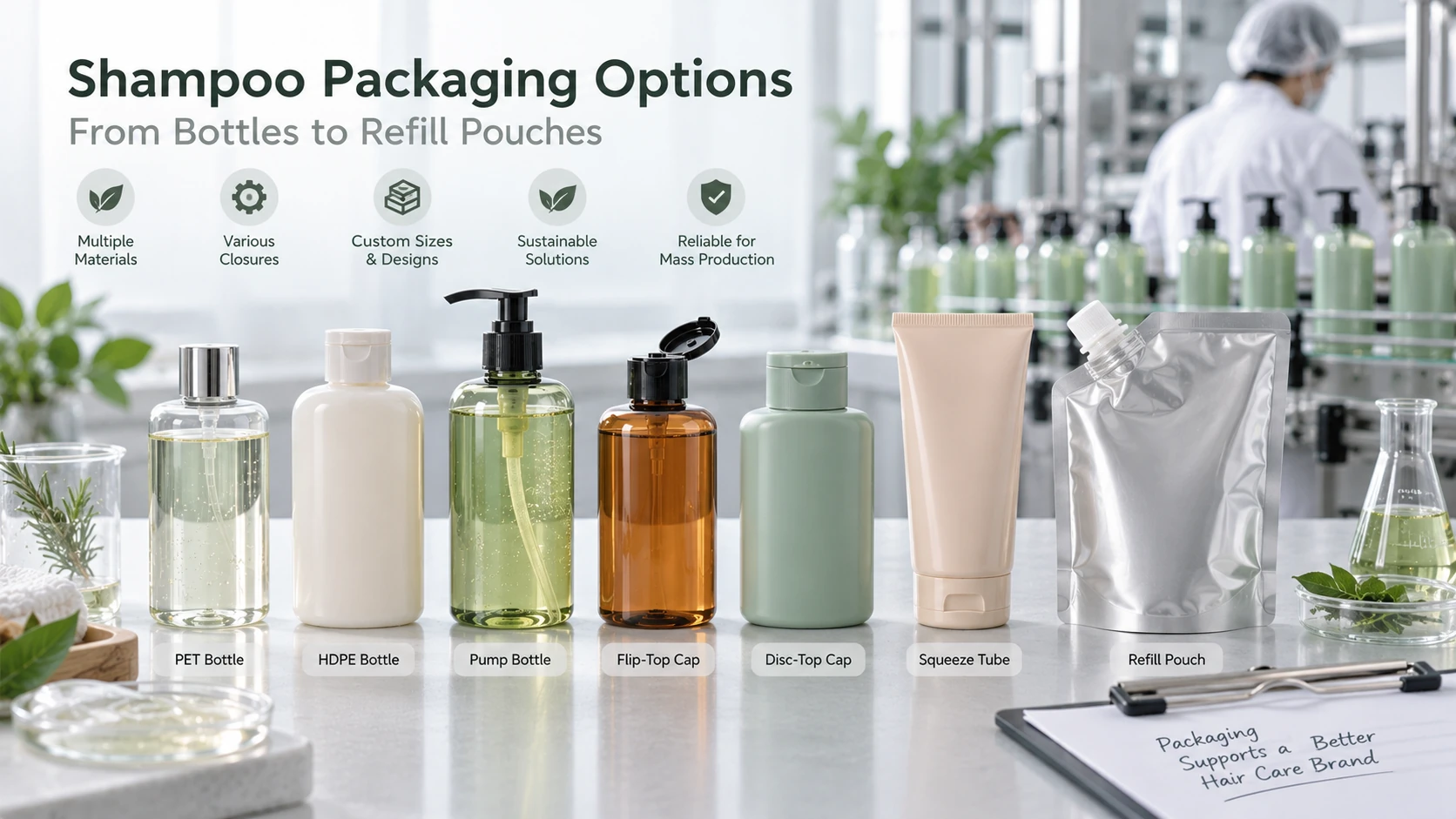
Choosing shampoo packaging involves more than finding a bottle that looks attractive on a retail shelf.
A thick moisturizing shampoo may dispense poorly through an unsuitable pump. A lightweight formula may flow too quickly from a large flip-top opening. Even a well-designed refill pouch can create problems if the material, sealing structure or pouring experience has not been evaluated.
For brands planning private label shampoo development, these details affect product quality, consumer convenience, shipping reliability and repeat orders.
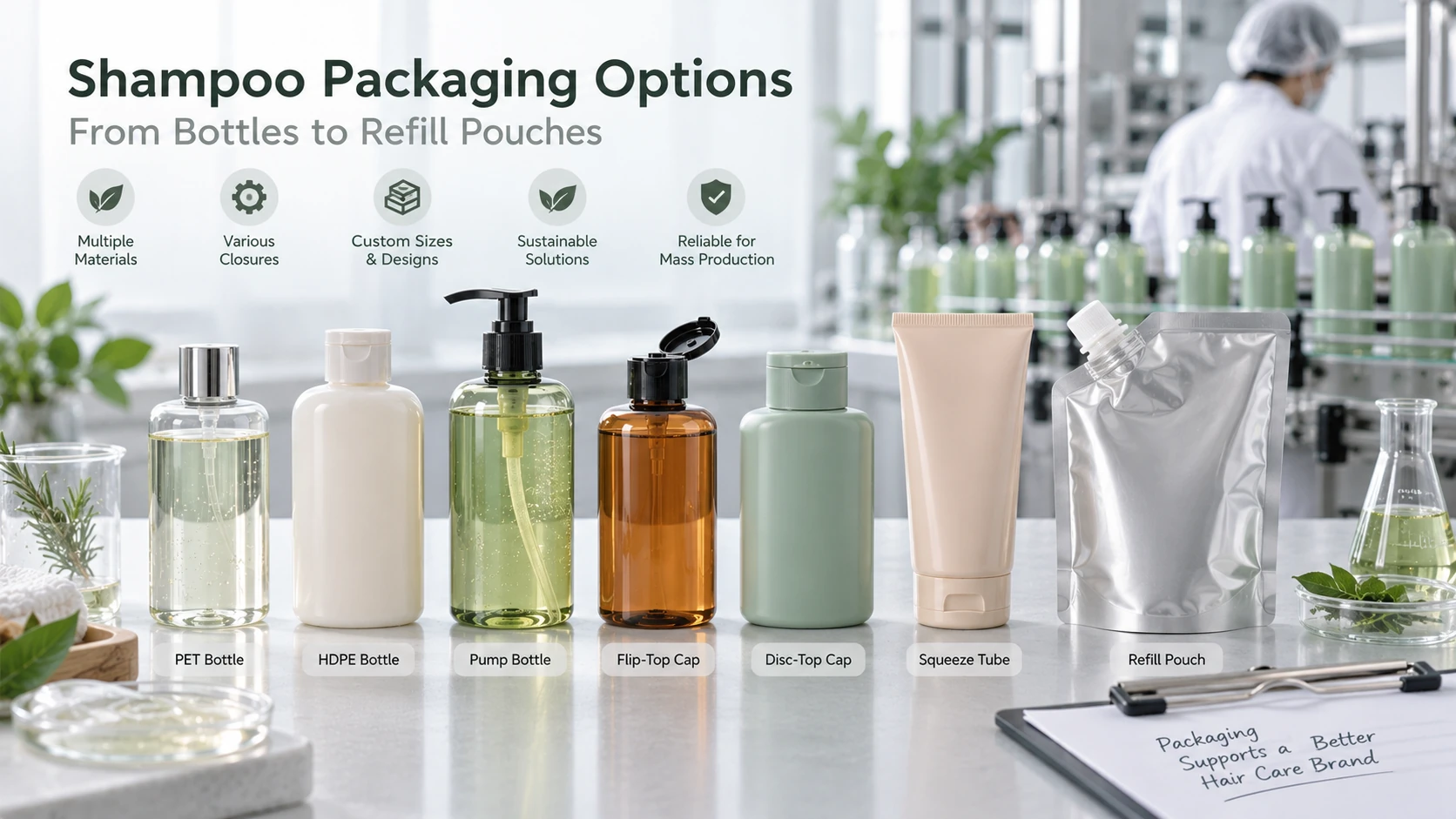
This guide compares shampoo bottles, pumps, caps and refill pouches, with practical considerations for selecting packaging that works with your formula, brand positioning and commercial manufacturing requirements.
Start With the Shampoo Formula and Sales Channel
Before choosing packaging, brands should consider how the shampoo will be used, where it will be sold and what the finished formula is expected to feel like.
A lightweight clarifying shampoo may require different dispensing characteristics from a rich moisturizing formula. A professional salon product often benefits from a larger pump bottle, while an everyday retail shampoo may work well in a compact flip-top container.
The sales channel matters just as much. E-commerce packaging needs to withstand individual parcel handling, while retail bottles must balance shelf presentation, label readability and customer convenience.
Packaging decisions should therefore begin alongside formula development, when viscosity, fragrance, appearance and target cost are being established.
Choosing Shampoo Bottle Materials: PET, HDPE and PCR
Bottle material affects appearance, durability, decoration options and compatibility with the finished shampoo.
PET and HDPE are commonly used for liquid shampoo packaging, while recycled-content materials offer additional options for brands with specific packaging objectives.
PET Bottles for Clear and Premium Shampoo Designs
PET bottles are lightweight, often transparent and available in a wide range of shapes.
They work well for shampoos where the formula's color or clarity contributes to the product presentation. Clear gels, botanical-inspired products and selected premium hair care lines may benefit from this approach.
PET bottles can also accommodate different labeling and decoration methods, depending on the container specification.
However, transparency is not always an advantage. Formulas containing light-sensitive ingredients or certain fragrance systems may require additional packaging evaluation.
HDPE Bottles for Practical and Professional Hair Care
HDPE is frequently selected for opaque shampoo bottles, including family-size and professional salon formats.
Its durability and design flexibility make it useful for products that need practical handling and a consistent appearance across larger packaging sizes.
Opaque bottles can also help conceal natural variations in formula appearance, although this should not replace appropriate stability testing.
For both PET and HDPE, material compatibility should be confirmed with the actual shampoo rather than assumed from the general properties of the plastic.
PCR Plastic and Recycled-Content Packaging
Post-consumer recycled plastic, commonly called PCR, can help brands reduce their use of virgin plastic when suitable recycled-content packaging is available.
PCR is not a separate plastic resin category. Shampoo bottles may use recycled PET or recycled HDPE, depending on the selected packaging system.
The recycled-content percentage, color consistency, material quality, decoration compatibility and supply availability should be confirmed before approving the design.
For brands developing premium packaging, consistency between production batches is especially important.
Bottle Size and Shape
Shampoo packaging sizes should reflect the intended sales channel.
Compact 100–200 mL formats may suit samples, selected travel ranges or product discovery sets, while 250–350 mL bottles are common choices for everyday retail. Larger 400–500 mL containers may support family-use products, with 750 mL and 1 L formats frequently considered for salon and professional applications.
These are planning examples, not fixed industry standards.
Bottle shape also affects usability. A container should be comfortable to hold with wet hands, stable on a bathroom shelf and suitable for the intended label design.
When requesting samples, brands should confirm the usable filling volume and distinguish it from the bottle's overflow capacity.
Shampoo Pumps: Matching Dispensing to the Formula
Pump bottles are popular for salon shampoos, premium hair care collections and larger household formats.
They provide convenient one-handed dispensing and can help consumers control how much shampoo they use.
However, a pump that works well with a lightweight shampoo may not perform consistently with a thicker conditioning formula.
Pump Output and Viscosity Compatibility
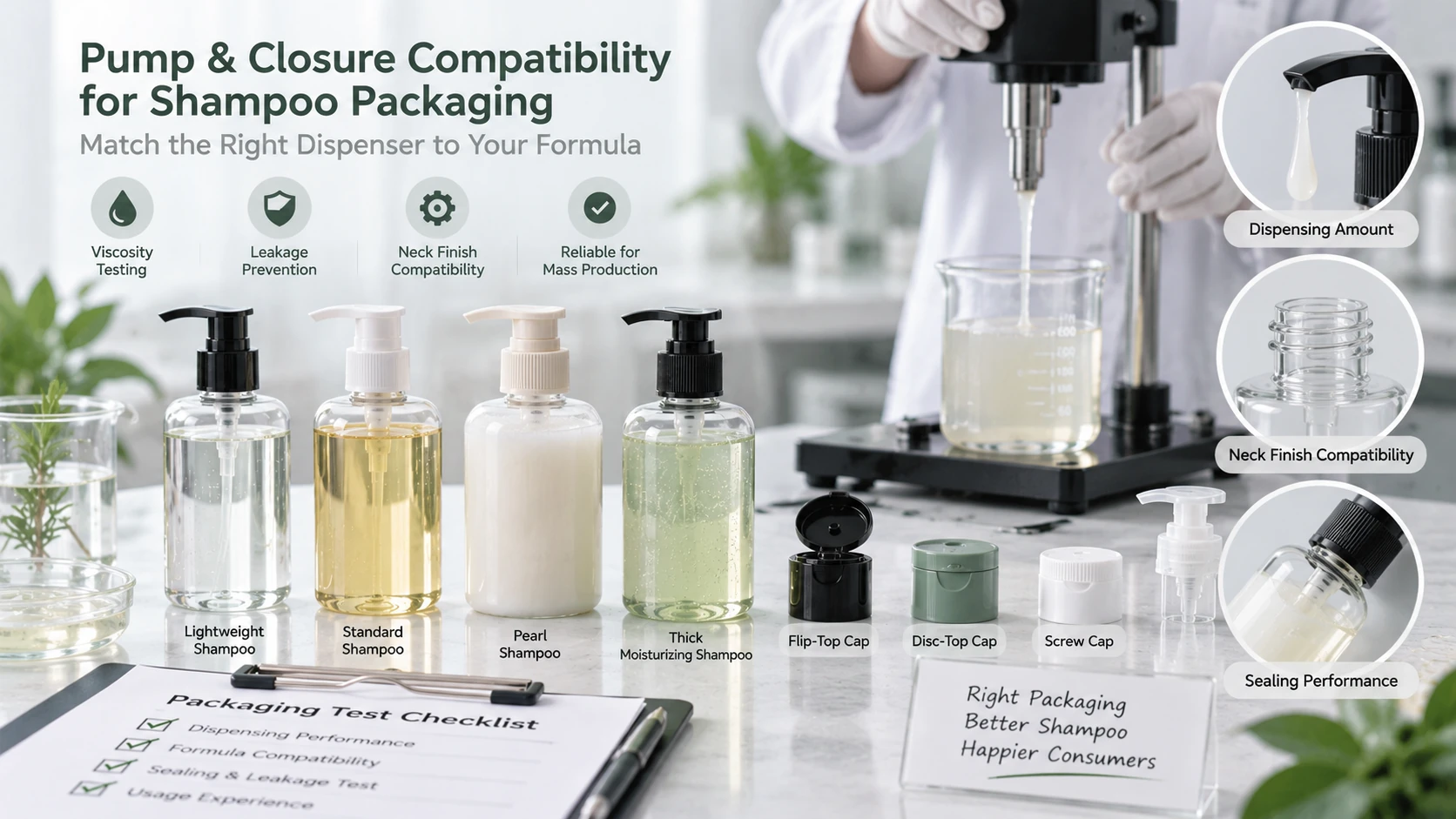
Pump selection should begin with the actual shampoo's viscosity and flow behavior.
The amount released per stroke, priming performance and consistency of dispensing all influence how the package feels during use.
A rich shampoo may require a pump designed for higher-viscosity liquids, while a thinner formula may need a smaller or more controlled output.
Brands should also evaluate how much product remains inside the bottle when the pump can no longer dispense efficiently.
This is particularly relevant for larger salon formats, where frequent use and product recovery can influence the overall customer experience.
Pump Fit, Locking and Leakage Protection
A pump must match the bottle's neck finish and thread specifications. The dip tube, sealing components and dispensing mechanism also need to suit the formula and container dimensions.
For e-commerce and export orders, a locking pump may provide additional transport security, but the complete assembly still needs leakage evaluation.
Brands should check pump performance with the filled bottle rather than approving the pump and container as separate components.
Shampoo Caps: Flip-Top, Disc-Top and Screw Closures
Not every shampoo requires a pump.
Flip-top, disc-top and screw caps remain practical choices for many retail, travel and everyday hair care products.
Flip-top caps allow consumers to open and close the bottle conveniently, making them suitable for shampoos used regularly in the shower. The opening size should match the formula's flow characteristics to avoid excessive dispensing or unnecessary squeezing.
Disc-top caps provide a compact appearance and can work well with selected retail bottle designs. Their dispensing performance depends on the opening, container flexibility and shampoo viscosity.
Screw caps offer a simple closure option, particularly for smaller bottles or specialized formats. Where needed, a suitable sealing system can provide additional protection during transportation.
Regardless of style, the closure should be checked for neck compatibility, sealing performance, ease of use and durability.
Which Shampoo Packaging Format Fits Your Brand?
The best packaging format depends on the formula, target customer and sales channel.
| Packaging Format | Suitable Applications | Main Consideration |
|---|---|---|
| Pump Bottle | Salon, premium and family-size shampoo | Pump output, viscosity and product recovery |
| Flip-Top Bottle | Everyday retail and family care | Opening size, grip and closure seal |
| Disc-Top Bottle | Compact retail and selected travel formats | Controlled dispensing and closure fit |
| Squeeze Tube | Travel and thicker shampoo concepts | Tube flexibility and dispensing pressure |
| Refill Pouch | Refill programs and larger-volume products | Film structure, sealing and pouring experience |
Packaging should be compared as a complete system rather than by the price of one component.
A low-cost bottle may still create higher finished-product costs if it requires additional protective packaging, inefficient filling or more complicated assembly.
Shampoo Refill Pouches: Developing a Practical Refill System
Refill pouches can support brands that want to offer additional purchase formats without requiring customers to buy a new rigid bottle every time.
For hair care businesses, they may work particularly well alongside established shampoo and conditioner ranges.
A refill system usually consists of a primary bottle designed for continued use and a pouch containing replacement product.
Spouted and Tear-Open Refill Pouches
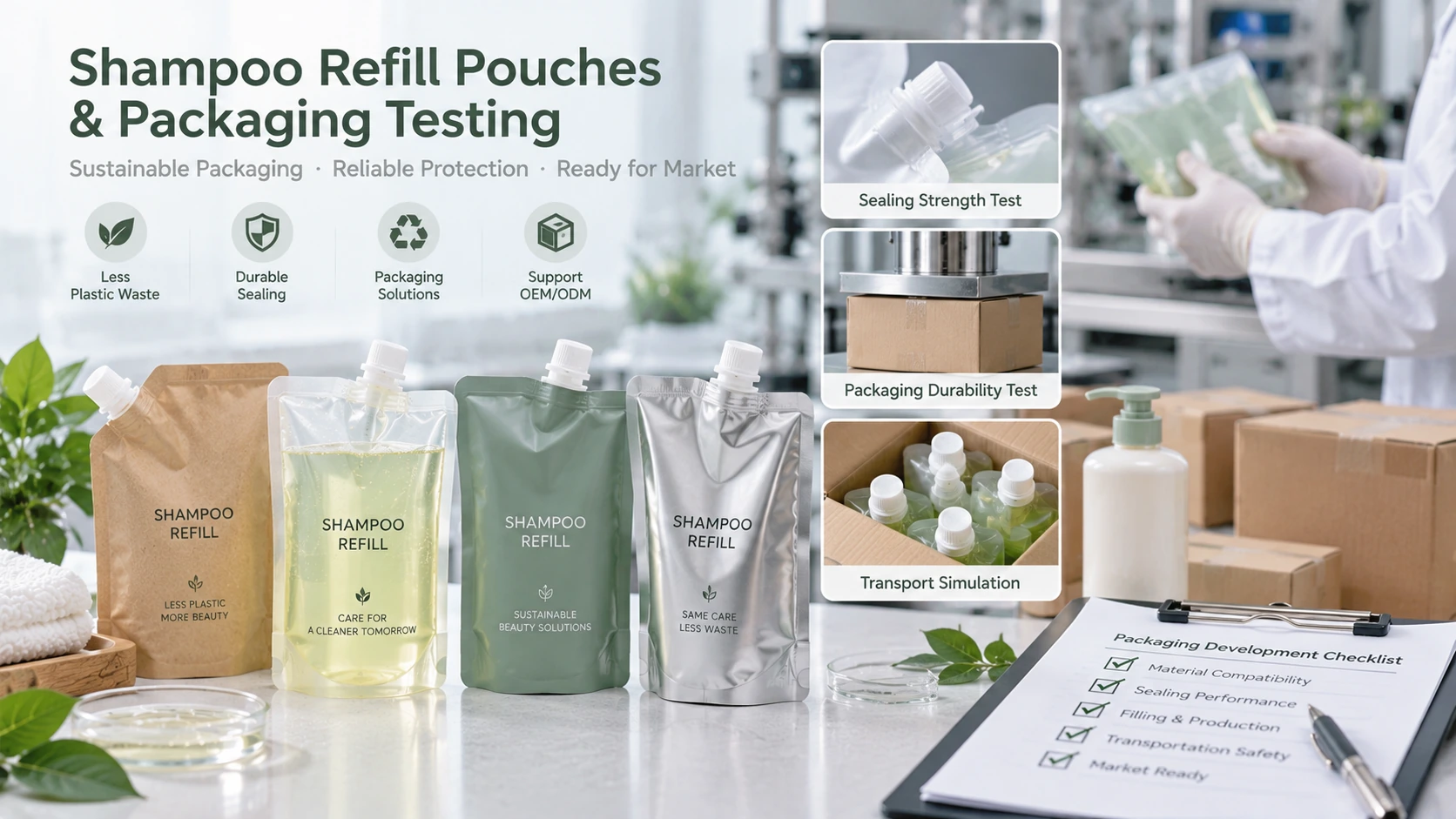
Spouted pouches have a fitted opening and closure that can make pouring more convenient. They may suit larger shampoo refill formats where customers need better control when transferring the product.
Tear-open pouches offer a simpler opening structure but need to be designed so consumers can pour the shampoo without excessive spilling.
Stand-up pouches are another structural option and may use either a spout or another opening system.
The most suitable design depends on shampoo viscosity, pouch capacity, film construction and intended use.
Film Compatibility and Sealing Performance
Many refill pouches use flexible multilayer films to provide strength and product protection.
The selected film must be compatible with the shampoo, while the pouch seams, spout and sealing areas must remain secure during filling, storage and transportation.
For thicker shampoos, pouring behavior and product residue inside the pouch should also be evaluated.
Brands should consider how consumers will refill the main bottle and provide appropriate instructions for safe, hygienic use.
A refill pouch should be easy to use without compromising the quality of the product inside.
Packaging Compatibility and Transport Testing
Packaging should be tested with the final approved shampoo formula before commercial production.
A bottle that performs well with water may respond differently when filled with shampoo containing fragrance, conditioning polymers, botanical ingredients or other formulation components.
Compatibility evaluation can help identify potential issues such as material interaction, discoloration, leakage and changes in dispensing performance.
Formula and Packaging Compatibility
Testing should consider the finished shampoo in the selected container under relevant storage conditions.
For example, changes in viscosity may affect pump output, while an unsuitable material or sealing component may create appearance or leakage problems over time.
The formula and packaging, including the container, closure and decoration, should be evaluated together rather than approved independently.
Filling, Sealing and Transportation
Packaging also needs to perform reliably on the production line.
Bottle dimensions, neck finish, closure application and filling characteristics can influence production efficiency.
Before approving bulk production, brands should review filled packaging samples for leakage, dispensing, closure security and label performance.
For e-commerce and export projects, relevant transport testing may include drop, vibration and compression assessments based on the intended distribution conditions.
These checks are particularly useful for shampoo multipacks, larger salon bottles and refill pouches shipped through individual parcel networks.
Sustainable Shampoo Packaging: Materials and Claims
Sustainable packaging decisions should be based on the complete packaging system rather than one material claim.
PCR plastic, lighter bottles, refill formats and simplified packaging structures may be worth evaluating, but each option has different performance and supply considerations.
A refill pouch is not automatically recyclable, and a bottle made with recycled material is not necessarily the best choice for every product.
Brands should confirm recycled-content documentation, material specifications and available recycling pathways before making environmental claims.
For the European Union, Regulation (EU) 2025/40 on packaging and packaging waste began applying on 12 August 2026, with specific requirements taking effect according to their respective timelines and conditions.
Brands supplying the EU should review the obligations relevant to their packaging materials, product type and planned launch date, including applicable recyclability, recycled-content and labeling requirements.
Specific, verifiable environmental statements are preferable to broad claims such as "100% sustainable."
What Should Buyers Confirm Before Approving Shampoo Packaging?
Packaging approval should involve more than selecting a bottle shape and approving the artwork.
The following checks help brands communicate more clearly with their OEM/ODM manufacturing partner
| Approval Area | What Buyers Should Confirm |
|---|---|
| Formula Compatibility | Material suitability, viscosity and storage performance |
| Bottle & Closure | Capacity, neck finish, pump or cap specifications |
| Consumer Use | Dispensing, grip, opening and product recovery |
| Production | Filling suitability, sealing, labeling and assembly |
| Shipping | Leakage resistance, carton protection and transport conditions |
| Commercial Supply | MOQ, component cost, decoration, lead time and repeat-order availability |
Custom molds, exclusive colors, special pump finishes and complex decoration can affect both minimum order quantities and lead times.
For brands preparing an initial launch, standard packaging combined with customized labeling or decoration may offer a practical starting point. More exclusive components can be considered when the brand's volume and positioning justify the additional investment.
Building a Coordinated Shampoo and Conditioner Packaging Line
Packaging planning becomes more valuable when a brand is developing several related products rather than one shampoo SKU.
A shampoo and conditioner range may use matching bottle shapes, colors and label structures to create a consistent visual identity.
However, matching appearance does not always mean both products should use identical dispensing components.
Conditioner is often more viscous than shampoo, so the pump or closure needs to be evaluated separately for each formula.
For professional salon lines, larger matching bottles can support a consistent working environment. Retail collections may instead use coordinated 250–500 mL formats, depending on the product positioning.
Refill pouches can also be developed as extensions of the core range, provided that the refill system remains practical for each formula.
Planning these formats together can help brands maintain a recognizable product family while allowing individual products to perform as intended.
Custom Shampoo Packaging Development With Poleview
Poleview Biotechnology Group Co., Ltd. supports private label shampoo brands with OEM/ODM development, packaging customization and commercial manufacturing.
We help buyers review packaging options alongside formula characteristics, including viscosity, fragrance, appearance, dispensing requirements and target sales channels.
Depending on the project, development may involve standard or customized bottles, pumps, closures, labels, cartons and refill formats.
Our approach is to align packaging selection with sample evaluation, production feasibility and the brand's commercial requirements before moving into bulk manufacturing.
If you are planning a new shampoo line, share your target market, product concept, preferred packaging format, estimated quantity and design references.
Explore our custom hair shampoo manufacturing services or discuss your packaging requirements with the Poleview team.
Shampoo Packaging FAQ
Q: 1. What is the best material for shampoo bottles?
A: PET and HDPE are common options. PET is often selected for clear or decorative bottle designs, while HDPE is frequently used for opaque and practical formats. The final choice should depend on the shampoo formula, required appearance, cost and packaging compatibility.
Q: 2. Are shampoo pump bottles better than flip-top bottles?
A: Neither format is universally better. Pumps can provide convenient dispensing for premium, salon and larger-volume products, while flip-top bottles are often practical for everyday retail shampoo. Formula viscosity, consumer use and packaging cost should guide the decision.
Q: 3. Can shampoo and conditioner use the same pump?
A: They may use matching pump designs, but each formula should be tested separately. Different viscosities and flow characteristics can affect pump output, priming and product recovery.
Q: 4. Are shampoo refill pouches more sustainable than bottles?
A: Refill pouches can reduce the amount of rigid packaging required in some systems. However, environmental performance depends on pouch materials, transport, consumer reuse behavior and available waste-management infrastructure. Claims should be supported by appropriate evidence.
Q: 5. What information should I provide for a shampoo packaging quotation?
A: Provide your target bottle or pouch capacity, estimated order quantity, preferred material, closure style, decoration requirements, destination market and shampoo formula details where available. These details help the manufacturer assess suitable options, compatibility and production feasibility.
Conclusion
Good shampoo packaging should protect the formula, dispense reliably and support the brand's intended consumer experience.
Whether choosing a PET bottle, salon pump, flip-top cap or refill pouch, the final decision should consider formula compatibility, commercial production, transportation and long-term supply.
By developing shampoo packaging alongside the formula, private label brands can reduce avoidable packaging problems and create products that are practical for both customers and manufacturers.