When developing a private label shampoo line, one important decision is whether to focus on clarifying shampoo, regular shampoo, or both.
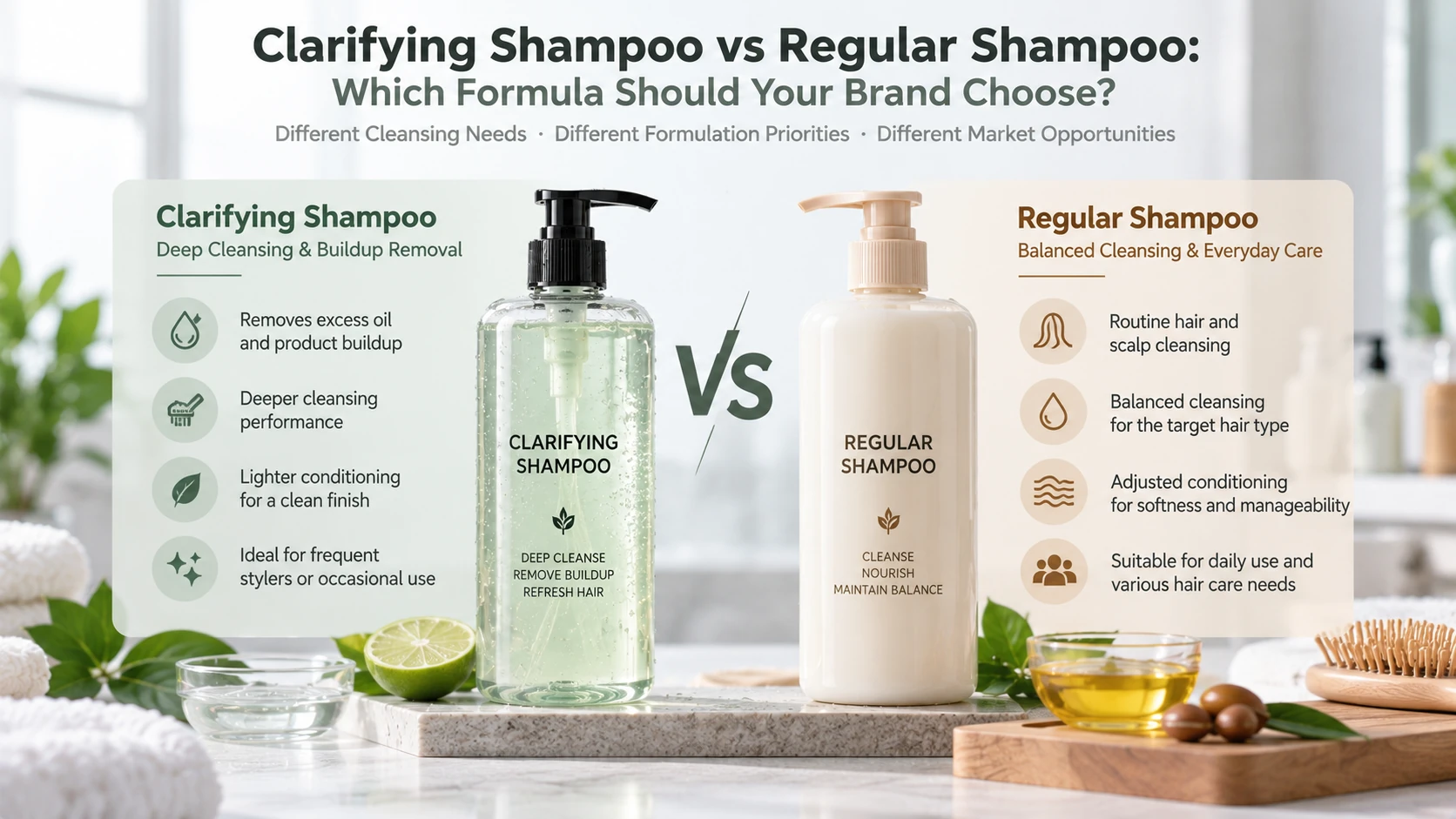
Although both products cleanse the hair and scalp, they are developed around different consumer needs. Clarifying shampoo typically focuses on removing excess oil and styling product buildup, while regular shampoo is designed for routine cleansing with a balance of washing performance and hair feel.
For hair care brands, this distinction influences more than product naming. It affects surfactant selection, conditioning performance, intended usage, marketing claims and the overall product collection.
This guide compares clarifying shampoo and regular shampoo to help brands choose the right formulation direction for their target customers.
Clarifying Shampoo vs Regular Shampoo: Key Differences
The main difference between clarifying shampoo and regular shampoo is their intended cleansing purpose.
Clarifying shampoo is generally formulated to remove accumulated oil, styling residue and other buildup that can leave hair feeling heavy or coated. It is often positioned as a deeper-cleansing product for consumers who use styling products frequently or want an additional cleansing step.
Regular shampoo is designed for routine hair washing. Depending on its positioning, the formula may prioritize moisturizing, volume, color care, scalp comfort or balanced cleansing.
| Feature | Clarifying Shampoo | Regular Shampoo |
|---|---|---|
| Primary Purpose | Remove excess oil and product buildup | Routine hair and scalp cleansing |
| Cleansing Focus | More intensive residue removal | Balanced cleansing for the intended hair type |
| Conditioning Approach | Often lighter to support a clean finish | Adjusted for softness, moisture or manageability |
| Typical Positioning | Deep cleansing, buildup removal, salon preparation | Daily care, moisturizing, volumizing, color care |
| Development Priority | Cleansing efficiency, rinsability and after-feel | Cleansing, conditioning and sensory balance |
These differences describe common formulation directions rather than fixed ingredient rules.
A clarifying shampoo does not necessarily need to contain sulfate surfactants, and a regular shampoo is not automatically less effective at cleansing. Actual performance depends on the complete formulation.
For private label brands, the better question is which cleansing experience the target consumer needs and how the formula should support that positioning.
How Do Clarifying and Regular Shampoo Formulas Differ?
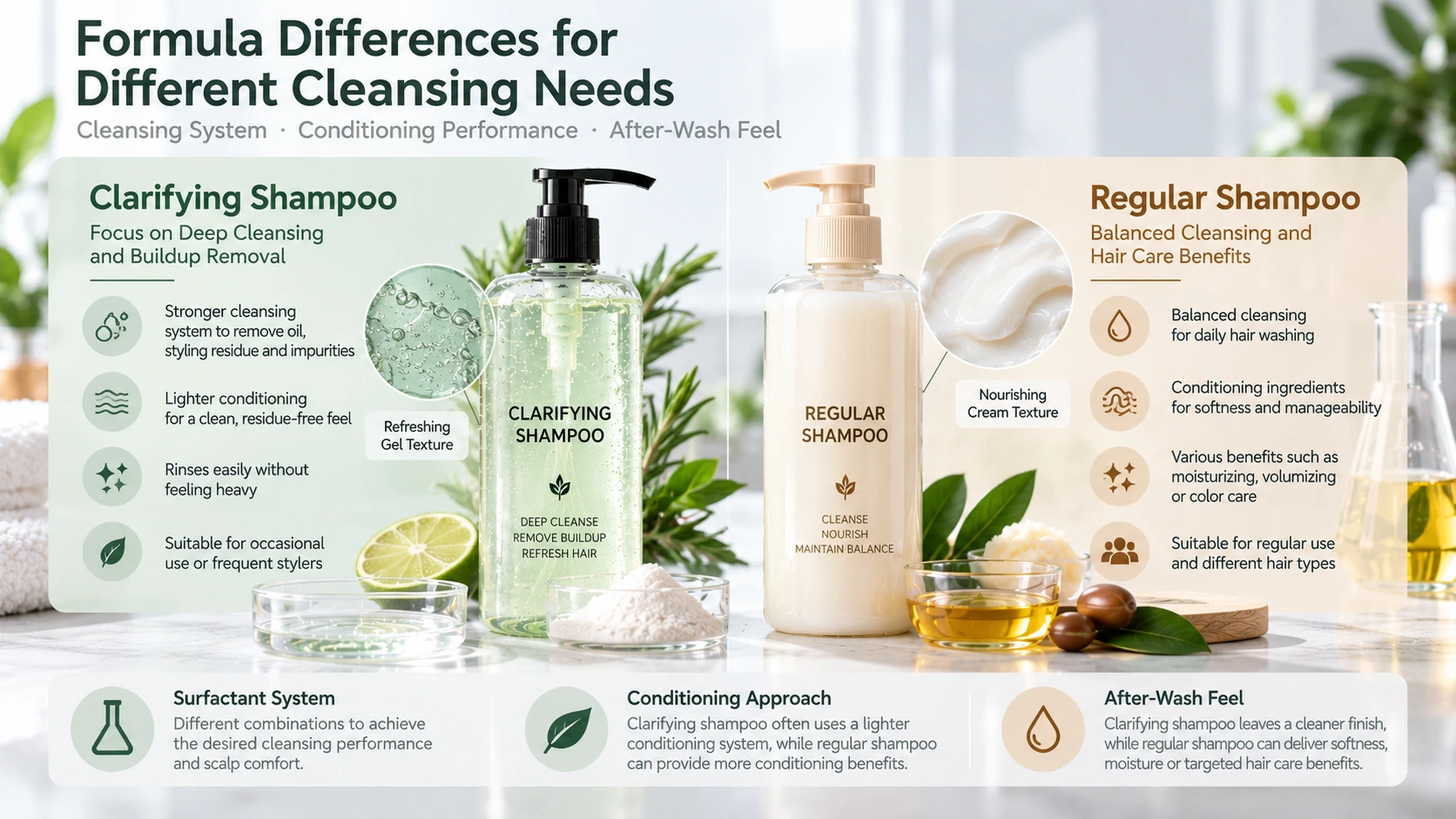
Both products rely on surfactants to remove oil, dirt and residue. However, the formulation approach may change depending on the intended cleansing performance and after-wash experience.
Surfactant Selection and Cleansing Performance
Clarifying shampoo formulations generally place greater emphasis on removing excess sebum and styling product buildup.
The surfactant system must deliver the desired cleansing performance without creating unnecessary dryness, tangling or an uncomfortable scalp feel.
Regular shampoo formulations may use different cleansing systems depending on the target hair type. For example, a daily moisturizing shampoo may prioritize comfortable cleansing and manageability, while a volumizing shampoo may focus on removing excess oil without leaving hair feeling heavy.
Both sulfate-based and sulfate-free surfactant systems can be considered for these products.
The appropriate choice depends on the complete formula, cleansing targets and consumer expectations rather than one ingredient alone.
Conditioning Ingredients and After-Wash Feel
Conditioning is another important difference.
Clarifying shampoo may use a lighter conditioning approach to support a clean, residue-free feeling. However, this does not mean the formula must be completely free of conditioning ingredients.
Regular shampoos often provide more flexibility for conditioning performance. A moisturizing formula may include selected polymers or other conditioning agents to improve softness and wet combability, while a volumizing shampoo may require a lighter finish.
For both product types, cleansing and conditioning should be evaluated together.
A shampoo that removes buildup effectively but leaves hair excessively tangled may not deliver a satisfactory consumer experience.
Clarifying Shampoo vs Chelating Shampoo
Clarifying and chelating shampoos are related concepts, but they are not interchangeable.
Clarifying shampoo generally targets excess oil and styling product residue. Chelating shampoo is designed to address mineral-related deposits, including calcium and magnesium associated with hard water.
Some formulas can combine clarifying and chelating functions, depending on their ingredients and development objectives.
If hard-water mineral removal is an important product benefit, manufacturers should evaluate an appropriate chelating system rather than assuming that stronger cleansing alone will achieve the desired result.
Brands should also ensure that mineral-removal claims are supported by suitable product evidence.
Which Shampoo Formula Fits Your Target Market?
Choosing between clarifying and regular shampoo begins with understanding how the target consumer uses hair care products.
A consumer who frequently applies styling creams, dry shampoo or hair oils may have different cleansing needs from someone who washes their hair regularly with a lightweight routine.
Similarly, salon professionals may require a specialized cleansing product alongside their regular shampoo and conditioning range.
| Target Consumer or Need | Recommended Product Direction |
|---|---|
| Frequent styling product users | Clarifying shampoo for buildup removal |
| Oily roots and noticeable residue | Deep-cleansing shampoo |
| Routine hair washing | Regular shampoo |
| Dry or damaged-feeling hair | Conditioning-focused regular shampoo |
| Color-treated hair | Color-care shampoo with suitable cleansing performance |
| Professional salon customers | Clarifying shampoo paired with appropriate conditioning care |
These recommendations are starting points. The final product should be developed around the consumer's hair type, usage habits and expectations.
For Deep Cleansing and Buildup Removal
Clarifying shampoo may be a suitable choice for brands targeting consumers who use styling products frequently or experience noticeable oil and residue accumulation.
In these products, the development priority is effective cleansing with satisfactory rinsability and after-wash comfort.
Brands can position the product around occasional deeper cleansing, provided the intended usage is appropriate for the finished formula.
For Everyday Hair Care
Regular shampoo offers broader opportunities for brands building a core hair care range.
Moisturizing, volumizing, gentle-cleansing and color-care concepts can all be developed under a regular shampoo line, with performance adjusted to different hair types.
For brands launching their first shampoo product, a well-positioned regular shampoo may provide a practical foundation for a broader collection.
For Color-Treated or Dry Hair
Consumers with color-treated or dry, damaged-feeling hair may require closer attention to cleansing strength and conditioning performance.
A clarifying shampoo should not automatically be positioned as suitable for frequent use on every hair type. If color-safe or gentle-cleansing benefits are intended, the claims should be evaluated against the finished formula.
For these consumers, a balanced regular shampoo or a specially developed cleansing formula may be more appropriate.
How Should Brands Choose the Right Shampoo Formula?
A successful product concept begins with a clear understanding of the problem the shampoo is intended to solve.
If the brand's customers frequently use styling products and want a more thorough wash, clarifying shampoo may provide a meaningful point of differentiation.
If the objective is routine cleansing with moisturizing, volumizing or other targeted benefits, regular shampoo may offer greater flexibility.
The intended usage frequency should also influence development. A product designed for occasional deeper cleansing may require a different balance of surfactants and conditioning ingredients from one marketed for frequent washing.
During sample evaluation, brands should look beyond foam volume and fragrance. Cleansing performance, rinsability, wet combability, scalp comfort and after-wash feel all contribute to the finished product experience.
Where a brand wants to make specific claims, such as removing styling buildup or helping preserve hair color, appropriate performance evidence should be considered during development.
The goal is not to develop the strongest possible cleansing formula. It is to create a shampoo that performs as expected for its intended consumer.
Should Your Brand Offer Both Clarifying and Regular Shampoo?
Clarifying shampoo and regular shampoo do not need to compete within the same product collection.
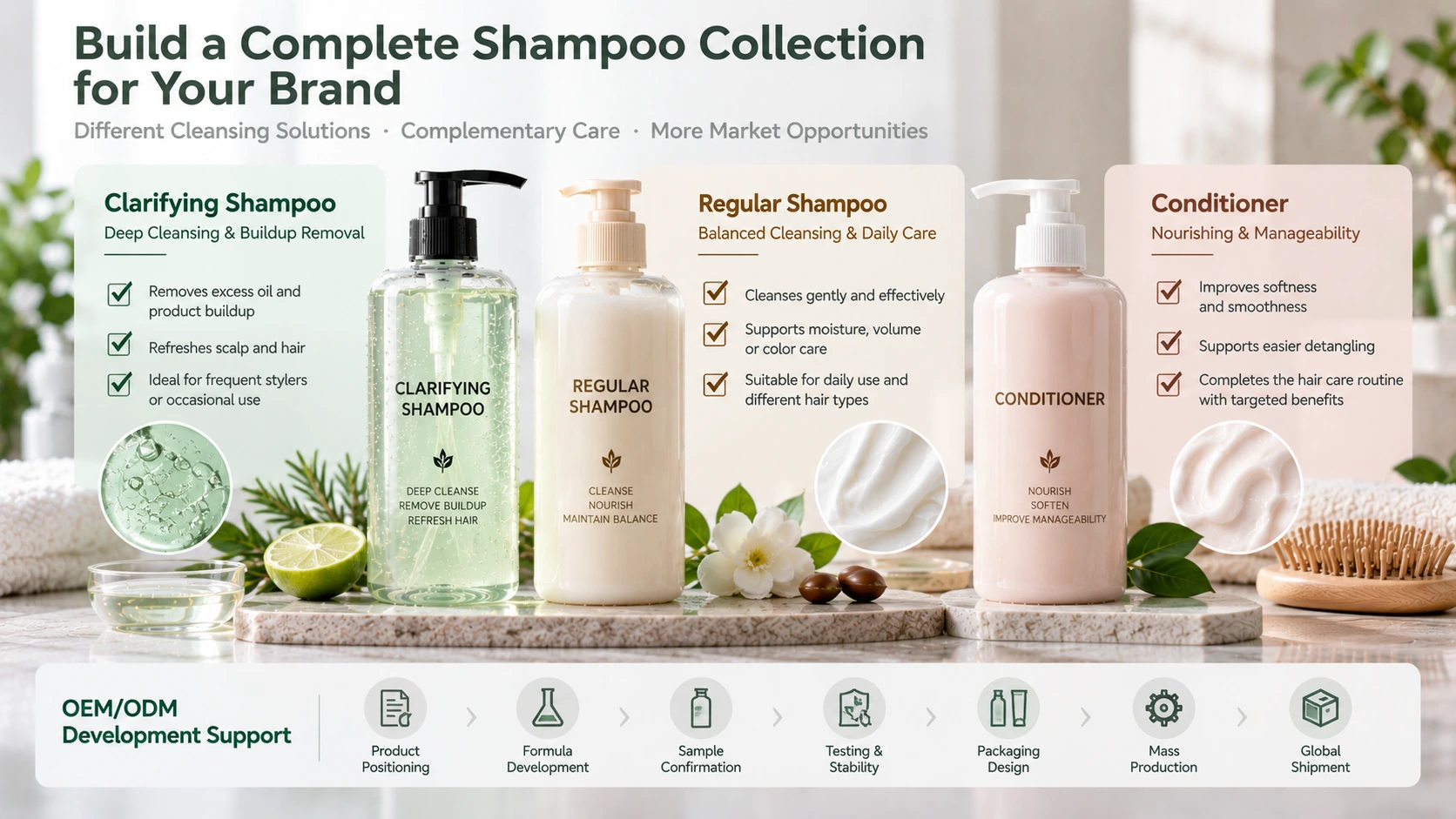
For brands building a complete hair care range, the two formats can serve complementary purposes.
A moisturizing shampoo may act as the main routine-cleansing product, while a clarifying shampoo offers an additional option for consumers who want occasional deeper cleansing.
A suitable conditioner or hair mask can further support the collection by addressing softness, manageability and other conditioning needs.
This approach allows brands to offer different cleansing experiences without relying on one formula to meet every consumer requirement.
However, launching both products is not always necessary.
For a new brand with a limited initial product range, it may be more practical to begin with the formula that best matches its core audience. Additional cleansing or conditioning products can be introduced as the collection develops.
Custom Clarifying Shampoo Formulation for Private Label Brands
Developing a private label clarifying shampoo involves more than choosing a stronger surfactant.
The formula should be designed around the intended level of cleansing, target hair type, usage pattern and overall consumer experience.
Some brands may prefer a traditional surfactant system for effective oil and residue removal, while others may explore sulfate-free clarifying shampoo formulations.
Both approaches are technically possible, but neither guarantees a particular level of mildness or performance without evaluating the complete formula.
Texture and fragrance also influence the finished product. A clear gel may suit a lightweight cleansing concept, while another formula may require a different appearance or sensory profile.
Conditioning ingredients should be selected carefully to support hair manageability without compromising the intended clean finish.
During development, the manufacturer should evaluate the formula's stability, packaging compatibility, microbiological quality and suitability for commercial production.
For brands selling in the US or European markets, ingredient selection, labeling and product claims should also be reviewed according to the applicable requirements.
Common Mistakes When Developing Clarifying Shampoo
One common mistake is assuming that clarifying shampoo must provide the strongest possible cleansing.
Excessive cleansing is not necessarily desirable, particularly when the product is intended for consumers with dry, damaged or color-treated hair.
Another mistake is treating sulfate-free as a guarantee of mildness or reduced cleansing performance. The result depends on the surfactant blend and the complete formula.
Brands should also avoid promising mineral removal simply because a shampoo is described as clarifying. A product intended to address hard-water deposits may require additional formulation considerations and supporting tests.
Finally, packaging and production requirements should not be left until the end of development.
A shampoo that performs well in a laboratory sample still needs appropriate stability testing, packaging compatibility evaluation and production controls before commercial launch.
Addressing these issues early can help reduce unnecessary sample revisions and improve product consistency.
Develop Custom Clarifying Shampoo With Poleview
Poleview Biotechnology Group Co., Ltd. supports international hair care brands with customized shampoo formulation and OEM/ODM manufacturing services.
Depending on the project requirements, brands can explore clarifying, moisturizing, sulfate-free and other targeted shampoo concepts.
Our development approach considers cleansing performance, conditioning feel, fragrance, texture and packaging requirements together, helping brands translate a product concept into a formula suitable for testing and commercial manufacturing.
Whether you are planning a standalone clarifying shampoo or developing a coordinated shampoo and conditioner collection, clear product positioning is the starting point.
Explore our custom hair shampoo manufacturing services to learn more about OEM/ODM shampoo development.
Clarifying Shampoo vs Regular Shampoo FAQ
Q: 1. Can clarifying shampoo be sulfate-free?
A: Yes. Sulfate-free clarifying shampoos can be developed using suitable surfactant blends. Cleansing performance depends on the finished formula rather than the presence or absence of SLS or SLES alone.
Q: 2. Can clarifying shampoo be used for color-treated hair?
A: It depends on the formula and intended usage. Brands developing clarifying products for color-treated hair should evaluate cleansing strength, hair feel and color-care performance before making related claims.
Q: 3. What is the difference between clarifying and chelating shampoo?
A: Clarifying shampoo generally focuses on excess oil and styling product buildup. Chelating shampoo uses appropriate ingredients to help address mineral-related deposits, such as those associated with hard water. Some formulas combine both functions.
Q: 4. Can brands customize clarifying shampoo formulations?
A: Yes. Private label brands may customize the surfactant system, conditioning level, fragrance, texture, packaging and intended cleansing performance according to project requirements.
Q: 5. Should a hair care brand offer both clarifying and regular shampoo?
A: Both can work within one product collection. Regular shampoo may serve routine cleansing needs, while clarifying shampoo provides an additional deep-cleansing option. The decision should depend on the brand's target consumers, product positioning and launch strategy.
Conclusion
Clarifying shampoo and regular shampoo serve different purposes, but neither is universally better.
The right choice depends on the target consumer, desired cleansing performance, hair feel and product positioning.
For private label brands, understanding these differences helps create clearer product concepts, improve formulation decisions and build a shampoo collection that addresses real consumer needs.