The hair care market is no longer built only around shampoo and conditioner. Consumers are paying more attention to oiliness, dryness, buildup, sensitivity and the general feeling of scalp comfort. This creates opportunities for beauty brands, retailers, salons and e-commerce companies to build more focused hair care ranges.
A scalp care concept may look straightforward at the beginning. A brand chooses a product format, selects several attractive ingredients and develops packaging around the idea. In practice, however, every decision affects the next one. Product positioning influences formula design. Formula viscosity affects packaging. Intended claims influence ingredient selection, testing, artwork and regulatory planning.
The strongest launch is not necessarily the one with the most products. A focused range built around a clearly defined consumer, one primary scalp concern and one convincing hero product is often easier to explain, manufacture and scale.
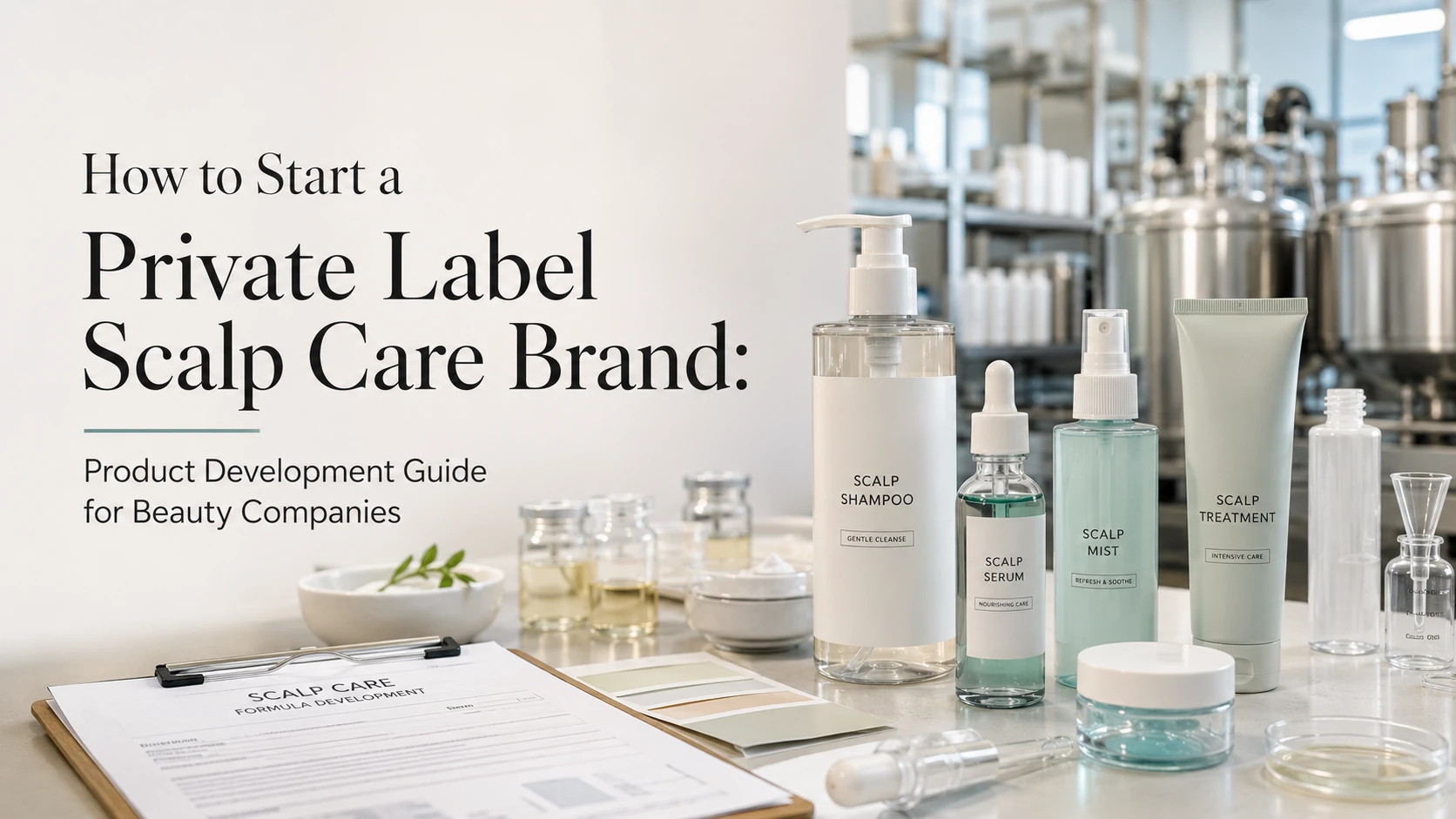
This guide explains how beauty companies can turn a scalp care idea into a practical private label product development plan, from choosing the right development route and preparing an OEM brief to formula development, packaging, testing, compliance and commercial production.
For a broader overview of available formats, formula options and manufacturing considerations, brands can also refer to our private label scalp care product development guide.
Define the Consumer, Scalp Concern and Brand Position
Before selecting a formula, define who the product is for and what role it should play in that consumer's routine.
A common mistake is trying to create one product that addresses oily roots, dryness, sensitivity, buildup, hydration and hair appearance at the same time. This usually leads to unclear positioning and makes formula development more difficult. A stronger starting point is one target consumer, one primary scalp concern and one clear product purpose.
An oily-scalp concept, for example, may focus on effective cleansing and a fresh after-feel without positioning the formula as excessively stripping. A dry or sensitive-feeling scalp concept may place greater emphasis on mild cleansing, hydration and comfort. An active-lifestyle brand may be more interested in post-workout freshness or between-wash use.
The product format should support this purpose. A rinse-off shampoo, leave-on serum, exfoliating treatment and refreshing mist do not perform the same role, even when they use some of the same ingredients.
Brand positioning also affects later decisions. A botanical wellness range may favor a natural ingredient story and softer sensory direction. A salon-oriented product may require more premium packaging and a clearly defined professional routine. A science-led brand may place greater emphasis on functional ingredients, testing and precise application.
Price level and sales channel should be considered at the same stage. A product intended for direct-to-consumer e-commerce has different shipping and communication needs from a product sold through salons, specialty retailers or distributors.
By the end of this first stage, the brand should be able to describe the concept in one or two sentences. For example:
A lightweight daily scalp serum for consumers experiencing oily roots and product buildup, positioned as a premium botanical product for direct-to-consumer sale in the United States.
That short description gives the manufacturer a much clearer foundation than a request such as "We want a rosemary scalp product."
Choose the Right Product Development Route
Not every scalp care brand requires a completely new formula. The appropriate development route depends on the desired level of differentiation, available budget, launch schedule, initial order quantity and long-term product plan.
Manufacturers may use slightly different terminology, but projects generally follow one of three routes.
| Development Route | Best Suited To | Main Advantage | Important Consideration |
|---|---|---|---|
| Ready Private Label Formula | Brands seeking a more direct route to market | Fewer formula development stages | Customization and differentiation may be limited |
| Semi-Custom Development | Brands that want selected changes to an existing formula | Balances development efficiency with brand differentiation | The available changes depend on the base formula and testing requirements |
| Custom ODM Development | Brands with a specific formula, texture, ingredient or application concept | Greater control over the finished product experience | Usually involves additional sampling, testing and development work |
Brands can compare ready formulas, semi-custom development, full custom ODM and contract manufacturing through our private label and custom ODM manufacturing services.
A ready private label formula may still allow customization of fragrance, color, packaging or selected ingredients, depending on the product and manufacturer. It should not be assumed that every component can be changed without affecting formula stability or requiring further evaluation.
Semi-custom development can be practical for companies that want more distinction without starting every technical decision from the beginning. A brand may work from a proven formula platform while adjusting the sensory profile, botanical story, appearance or selected functional ingredients.
Custom ODM is more suitable when the product concept depends on a particular texture, application method, ingredient system or performance direction. It can provide stronger differentiation, but the project should allow enough room for formula trials, package matching, testing and approval.
None of these routes is automatically better. The right choice is the one that supports the brand's commercial plan without adding unnecessary development complexity.
Build a Focused First Product Range
A new scalp care brand does not need to begin with six or ten SKUs. One hero product supported by one or two complementary products is often a more manageable launch strategy.
This approach simplifies inventory, packaging development, product education and marketing. It also gives the brand time to collect customer feedback before expanding the range.
| Product Format | Role in the Routine | Suitable Brand Direction | Main Development Focus |
|---|---|---|---|
| Scalp Shampoo | Cleanse | Daily care, oily scalp, clarifying or gentle care | Surfactant balance, foam, rinse feel, viscosity and after-feel |
| Scalp Serum | Treat or maintain | Premium, targeted or science-led care | Lightweight texture, direct application, leave-on comfort and packaging |
| Scalp Scrub | Exfoliate | Buildup removal and intensive cleansing concepts | Exfoliation method, application comfort and rinse performance |
| Scalp Mist | Refresh | Active lifestyle and between-wash routines |
Spray quality, low residue, fragrance and portability |
Scalp Shampoo
A scalp shampoo is a familiar entry point for consumers and can support regular repeat purchase. It may be developed for daily cleansing, oily-scalp care, gentle cleansing, moisturizing or clarifying positioning.
The development challenge is balance. Stronger cleansing does not automatically create a better scalp care product. The surfactant system, foam, rinse feel, fragrance, pH, viscosity and conditioning effect all contribute to the experience.
For a new brand, a shampoo may work well as the foundation of a wider routine, particularly when the concept can be explained clearly on the product page and packaging.
Brands choosing shampoo as the hero SKU can also review Poleview's private label shampoo manufacturing options.
Scalp Serum
A leave-on scalp serum gives a brand more space to create a targeted product story. It can support botanical, premium, moisturizing, refreshing or functional positioning and may be used as the hero product in a more specialized range.
The formula generally needs to feel lightweight and distribute easily along the scalp without leaving the hair heavy or greasy. The applicator is equally important. A precision nozzle, pump, dropper or comb-style applicator can substantially change how the product is used.
Brands considering this format can review the more detailed private label scalp serum development guide, which covers formula direction, texture, packaging and manufacturing considerations.
Scalp Scrub or Exfoliating Treatment
A scalp scrub can add a distinctive treatment step to a product range, but it requires clear consumer instructions. Physical exfoliants, acids and enzyme-based systems create different product experiences and are not interchangeable.
The exfoliation approach should match the intended user. A product positioned for sensitive-feeling scalps should not be developed in the same way as an intensive buildup-removal treatment.
Because consumers may not use this type of product every day, brands should also consider expected usage frequency, pack size and how the scrub fits alongside shampoo.
Scalp Mist
A refreshing scalp mist can support post-workout routines, oily roots, between-wash use and on-the-go freshness. It may work particularly well for lifestyle-oriented brands.
The formula needs to spray consistently and dry with minimal residue. Fragrance can be important, but it should not overwhelm the user or conflict with other products applied to the hair.
For many new businesses, the mist is more effective as a supporting product than as the entire brand proposition. It can extend the routine after a shampoo or serum has established the core concept.
Set the Commercial Guardrails Before Formula Development
Product development should begin within a realistic commercial framework.
Before finalizing the formula direction, define the intended sales channel, target retail price, expected product cost, first order quantity and target launch date. These factors influence the formula, packaging and manufacturing route.
A brand selling primarily through its own website may prioritize shipping durability, content-friendly packaging and healthy direct-to-consumer margins. A salon brand may focus more on professional presentation, application convenience and stylist education. A retail project may need to accommodate distributor or retailer margins, shelf presentation and specific packaging requirements.
The target retail price should be discussed before premium ingredients and complex packaging are added. Product cost is not limited to the bulk formula. The complete project may include the container, closure, applicator, decoration, label, carton, filling, testing, freight, import costs and market-specific regulatory work.
Initial order quantity matters as well. A highly customized bottle, multi-component applicator or special decoration process may require a different minimum order from a standard package. Similarly, a fully customized formula may not follow the same development route as an existing private label formula.
The launch date should be treated as a planning target rather than a fixed promise made before the scope is confirmed. Sampling, formula revisions, packaging sourcing, testing, artwork approval and production all require coordination. A realistic timeline protects the product from rushed decisions at the end of the project.
Prepare a Clear Scalp Care Product Brief

A good OEM brief allows the manufacturer to recommend a suitable development route instead of guessing what the brand needs.
The brief should explain the target country or region, target consumer, primary scalp concern, product format, intended use and desired cosmetic positioning. It should also identify any preferred ingredients, ingredients to avoid, fragrance direction, texture expectations, packaging ideas and product size.
Commercial information is equally important. Include the expected retail price, target product cost where available, estimated order quantity, sales channel and preferred launch date.
Reference products can help communicate texture, fragrance, packaging or application preferences. They should be used to explain the direction rather than request an exact copy of another brand.
A useful brief does not need to contain a finished technical specification. Its purpose is to give the R&D, packaging and sales teams enough context to evaluate feasibility and identify the decisions that still need to be made.
For example:
We are developing a 50 ml lightweight scalp serum for the U.S. direct-to-consumer market. The product is intended for consumers concerned about oily roots and buildup. We prefer a fresh, non-greasy texture, a botanical ingredient story and a precision nozzle package. Our initial order estimate is 5,000 units, and the target launch is the third quarter.
Even when some details remain open, this is far more useful than sending a list of ingredients without a product concept.
Develop the Formula Around Product Purpose and Claims
Formula development should start with the intended use of the product, not a collection of trending ingredients.
A rinse-off shampoo needs a cleansing system, foam profile and rinse feel appropriate for the target consumer. A leave-on serum needs to remain comfortable on the scalp and hair between washes. A mist must atomize correctly, while a scrub needs controlled exfoliation and suitable rinse performance.
Ingredient selection comes after these requirements are clear. Moisturizing ingredients, botanical extracts, cleansing agents, conditioning components and functional actives need to work within the complete formula rather than being evaluated in isolation.
For oily-scalp positioning, the goal is usually not to remove as much oil as possible. The formula should provide effective cleansing or a fresh feel without creating an unnecessarily harsh experience. A dry or sensitive-feeling scalp concept may require a milder system and a different balance of hydration, fragrance and sensory ingredients.
Botanical ingredients such as rosemary, green tea, centella asiatica, peppermint or tea tree-derived materials can support a compelling product story. However, natural origin does not remove the need to evaluate concentration, compatibility, color, odor, stability and overall safety.
Brands seeking a deeper review of ingredient roles can refer to the scalp care ingredients and formulation guide rather than repeating the entire ingredient-development process in the brand launch plan.
Decide the Claims Early
Product claims should be discussed before the formula, test plan and artwork are finalized.
For a cosmetic scalp care product, brands may consider wording related to cleansing, refreshing, moisturizing, improving the feeling of scalp comfort or helping maintain a clean and healthy-looking scalp. The final language should be truthful, supportable and suitable for the market where the product will be sold.
Claims can also affect how a product is regulated. In the United States, intended use is a key factor in determining whether a product is a cosmetic, a drug or both. An anti-dandruff shampoo may be regulated as both a cosmetic and a drug, while hair-regrowth or disease-treatment claims can place a product within drug requirements.
This means statements such as "treats alopecia," "cures scalp disease" or "regrows hair" should not be added casually to a cosmetic product page or package. Labeling, website content, advertising and other promotional materials can all contribute to intended use. Cosmetic claims in the U.S. must also be truthful and not misleading.
The manufacturer can help evaluate whether the proposed formula and product format support the intended concept, but the brand should confirm final claims and market classification with an appropriately qualified regulatory professional.
Develop the Formula and Packaging as One System
Packaging should be selected together with the formula rather than treated as the final design step.
A lightweight scalp serum may need a precision nozzle that allows the consumer to reach the scalp without coating the hair. A thicker exfoliating treatment may perform better in a tube or jar. A scalp mist needs a spray system that produces consistent output without clogging, leaking or delivering overly large droplets.
Viscosity, ingredient composition and application method can affect pump or spray performance. The package may also influence product recovery, dosage control and the consumer's perception of quality.
Package appearance still matters, but it should support the formula and sales channel. A heavy glass bottle may create a premium impression yet be less practical for certain shipping conditions. An intricate applicator may offer differentiation but introduce higher minimum quantities or longer sourcing requirements.
Formula–package compatibility should therefore be evaluated before mass production. Depending on the project, the assessment may look at leakage, deformation, discoloration, odor changes, formula separation, dispensing performance and stability under expected storage or transportation conditions.
The commercial product is not only the bulk formula. It is the combination of formula, primary package, closure or applicator, intended use and consumer instructions.
Test the Product Before Commercial Production
A successful laboratory sample still needs to prove that it can remain acceptable through filling, storage, transportation and consumer use.
The appropriate test plan depends on the formula, packaging, intended market and product risk profile. Stability work may monitor appearance, color, odor, pH, viscosity and physical condition under selected storage environments. Water-based scalp shampoos, serums and sprays also require suitable microbiological controls and preservation evaluation.
Packaging compatibility should be assessed using the intended commercial package rather than only a generic laboratory container. A formula can appear stable in a sample jar but behave differently after it is filled into a pump, nozzle or spray package.
Production suitability is another consideration. The formula must be capable of moving from a small development batch to commercial manufacturing while maintaining the expected appearance, texture and performance. Processing order, mixing conditions, filling behavior and batch consistency may all need to be reviewed.
Testing cannot guarantee that no issue will ever occur, but it provides evidence for making better production and launch decisions. It also helps identify formula or packaging problems before the brand has committed to a full commercial order.
For a more detailed explanation of sampling, scale-up, filling and quality control, see the scalp care manufacturing process guide.
Plan U.S. and EU Compliance Before Final Artwork
Regulatory planning should begin before production and preferably before the final formula and claims are locked.
The exact responsibilities depend on the target market, product classification, label arrangement and role of the manufacturer, importer, distributor and brand owner. An OEM partner may provide technical and production documents, but this does not automatically transfer every legal responsibility away from the brand or market-based responsible party.
U.S. Market Planning
For products sold in the United States, first confirm whether the intended use and claims keep the product within the cosmetic category. As noted above, anti-dandruff treatment and hair-regrowth claims can create drug or combined cosmetic-drug requirements.
The Modernization of Cosmetics Regulation Act of 2022 expanded FDA's authority over cosmetics. Where the requirements apply, manufacturers and processors must register their facilities and renew registration every two years. The responsible person must list each marketed cosmetic product, including product ingredients, and provide updates annually. Certain small-business and product-related exemptions may apply.
Facility registration and product listing are not FDA product approval, certification or promotional endorsement. FDA specifically states that these processes are neither a cosmetic approval program nor a promotional tool.
Brands should also plan for safety substantiation, compliant labeling, record management, adverse-event responsibilities and claims review as applicable to their role and product. Final artwork should not be approved until the required company information, ingredient declaration, net contents, directions, warnings and claims have been reviewed for the intended market.
EU Market Planning
For products placed on the European Union market, the responsible person must ensure that the cosmetic product has undergone a safety assessment and that a Cosmetic Product Safety Report is prepared before the product is placed on the market.
A Product Information File must also be maintained. Under Regulation (EC) No 1223/2009, the PIF is kept for ten years following the date on which the last batch of the product was placed on the market. It includes the product description, safety report, manufacturing information and GMP statement, together with other relevant documentation.
Before market placement, required product information must be submitted through the Cosmetic Products Notification Portal. The European Commission describes the CPNP as the online notification system implementing Article 13 of the Cosmetics Regulation. Once the product has been notified through the CPNP, further national notification is generally not required within the EU.
The brand should confirm who will serve as the Responsible Person, what documentation the manufacturer will supply, who will coordinate the CPSR and PIF, and who will complete the CPNP notification. Ingredient restrictions, fragrance labeling, artwork language and claims evidence should be reviewed according to the final formula and destination market.
Regulations and ingredient restrictions can change, and requirements vary by product and business role. Final compliance decisions should therefore be confirmed with a qualified regulatory professional before production and market launch.

Evaluate Manufacturer Fit Before Sampling
A manufacturer should be evaluated on its ability to support the complete project, not only on the price of the bulk product.
Begin by confirming which development routes are available. Ask whether the supplier offers ready private label formulas, semi-custom options and fully customized ODM development, and request a clear explanation of what each route includes.
The sample process should also be understood before the project begins. Confirm what information is required, whether sample revisions are available, how formula approval is recorded and when testing or packaging evaluation takes place.
Documentation support should be discussed in specific terms. Instead of asking only whether the manufacturer "supports the U.S. and EU," ask which documents can be provided for the selected product and which items must be prepared by the brand, importer, Responsible Person or third-party regulatory service.
MOQ and lead time should be confirmed for the complete product rather than for the bulk formula alone. The bottle, pump, decoration, carton and label may each have different purchasing conditions. A formula MOQ may not be the same as the minimum quantity required for customized packaging.
It is also useful to understand scale-up capability. A partner that can manage formula development, package sourcing, filling, quality control and later production growth may reduce unnecessary handovers as the brand expands.
Beauty companies looking for broader information about Poleview's product categories, customization options and production support can review our private label scalp care manufacturer page.
Launch With a Scalable Product Roadmap
A first launch should establish a clear reason for the brand to exist. Later products can extend that idea rather than introducing unrelated concepts.
One possible roadmap is:
Scalp Shampoo → Scalp Serum → Scalp Scrub → Scalp Mist
This creates a routine of:
Cleanse → Treat → Exfoliate → Refresh
It is only an example. A serum-led premium brand may begin with the treatment step and add shampoo later. A natural oil-based concept may follow a different sequence. A salon range may prioritize professional backbar and retail sizes.
Starting with fewer products makes it easier to monitor sell-through, reviews, repeat purchase and consumer questions. This information can guide the second launch more reliably than assumptions made before the first product reaches the market.
Scalability should still be considered from the beginning. Packaging architecture, naming, fragrance direction and visual design can be planned so that future products belong to the same family. Formula concepts should also be distinct enough that each additional SKU has a clear role rather than becoming a minor variation of the hero product.
Private Label Scalp Care Brand Launch Checklist
| Project Stage | Items to Confirm |
|---|---|
| Before Development | Target consumer, primary scalp concern, brand positioning, target market, sales channel, development route, hero product, target retail price, expected product cost, order estimate and launch target |
| Before Production | Final formula, approved sample, cosmetic claims, packaging components, formula–package compatibility, appropriate testing, ingredient list, artwork, market documentation, MOQ and production schedule |
| Before Launch | Final quality control, batch and shipping documents, product photography, e-commerce or retail content, directions for use, warnings where applicable, customer-service information and final market compliance review |
Frequently Asked Questions
Q: 1. How much does it cost to start a private label scalp care brand?
A: The total cost depends on the product format, development route, ingredients, packaging, decoration, testing, documentation, artwork and order quantity. A project using an existing formula and standard packaging generally involves fewer development stages than a fully customized ODM product. Brands should request a quotation based on the complete specification rather than comparing bulk formula prices alone.
Q: 2. What is the best first product for a new scalp care brand?
A: There is no universal best product. A scalp shampoo can provide a familiar daily-use entry point, while a scalp serum may offer more targeted and premium positioning. The decision should reflect the target consumer, primary concern, sales channel, expected price and ability to explain the product clearly. One strong hero product is usually more valuable than several poorly differentiated SKUs.
Q: 3. Should I choose a ready private label formula or custom ODM development?
A: A ready formula may suit brands seeking a more direct development route with limited changes. Semi-custom development offers a middle ground, while custom ODM is more appropriate when the brand requires a distinctive texture, ingredient system, application format or sensory experience. Budget, timeline, order volume and differentiation should be evaluated together.
Q: 4. What information should I send to a scalp care manufacturer?
A: Provide the target market, target consumer, main scalp concern, product format, intended claims, ingredient preferences, texture, fragrance, packaging idea, size, expected order quantity, target price and preferred launch date. Reference products or visual examples can also help explain the desired direction, provided they are used for communication rather than exact duplication.
Q: 5. How long does private label scalp care product development take?
A: The timeline varies according to the development route and project complexity. Existing formulas generally require fewer formulation stages, while custom projects may involve several sample rounds, package selection, compatibility work, stability or microbiological testing, artwork approval and production planning. A reliable timeline should be confirmed after the manufacturer reviews the full product brief.
Q: 6. What documents may be needed for U.S. or EU sales?
A: The required documents depend on the market, product and business arrangement. Buyers may request an INCI ingredient list, product specification, certificate of analysis, safety data information, microbiological results, stability information and manufacturing documentation. EU projects may also require manufacturer data supporting the CPSR and PIF process. U.S. projects should review MoCRA responsibilities, labeling and product classification. Final requirements should be confirmed with the relevant regulatory professional or Responsible Person.
Develop Your Private Label Scalp Care Brand With Poleview
Launching a scalp care brand requires a clear link between consumer need, formula design, packaging, testing, compliance and manufacturing. When these decisions are considered together, the product is more likely to fit its intended market and support future range expansion.
Poleview Biotechnology Group Co., Ltd. works with global beauty companies on private label and custom ODM scalp care projects. Support can include formula selection or development, sampling, packaging coordination, testing preparation, production and quality management according to the agreed project scope.
Before confirming bulk production, brands can also request private label scalp care samples to evaluate formula direction, texture, fragrance and packaging fit.
To begin a product discussion, prepare your target market, intended consumer, primary scalp concern, preferred product format, formula direction, packaging idea, estimated quantity and target launch date. A clear brief allows the development team to assess feasibility and recommend an appropriate route from concept to commercial production.
References
- U.S. Food and Drug Administration, Registration and Listing of Cosmetic Product Facilities and Products.
- U.S. Food and Drug Administration, Cosmetics and U.S. Law; Is It a Cosmetic, a Drug, or Both?
- European Chemicals Agency, EU Cosmetics Regulation profile.
- European Commission, Cosmetic Products Notification Portal.